Human Eye & Colourful World Topic Hub

Human Eye & Colourful World — Class 10 Notes

CBSE 2027 — dates, rules and official papers →
Physics · Ch 10Class 10 · CBSE 2026–27High weightage

The Human Eye and the Colourful World

What the board actually asks: the defect-to-lens question (myopia to concave, hypermetropia to convex, presbyopia to bi-focal) with its corrective ray diagram, power/focal-length numericals for a corrective lens, and 'explain why' reasoning on the twinkling of stars, advance sunrise, the blue of the sky and the red of danger signals. This chapter is almost entirely reasoning plus one short numerical.

NCERT VERBATIM sourced, word-for-wordAUTHORED LazyTopper teaching scaffolding
The Big Idea AUTHORED

One lens focuses your world; the sky paints it.

The eye lens focuses light onto the retina, and by changing its focal length (accommodation) it lets you see both near and far. When that adjustment fails you get myopia, hypermetropia or presbyopia, each corrected by a specific spectacle lens. The 'colourful world' half is pure refraction of sunlight: a prism splits white light into VIBGYOR (dispersion), the atmosphere bends starlight and sunlight (so stars twinkle and the Sun is seen about two minutes early at sunrise), and tiny particles scatter short-wavelength light more (so the clear sky looks blue, while red — the colour scattered least — is chosen for danger signals).

Formulae

Power of a Lens (Dioptre)

Power of a lens
 (dioptre, D)
Tip: f in metres.

Lens Formula

Lens formula
Tip: Use for the corrective-lens numerical.

Myopia and its Correction

Myopia correction
(concave)
Tip: Far point of a myopic eye: use a lens with f = −(far point distance); P is negative.

Hypermetropia and its Correction

Hypermetropia correction
object at , image at the near point; (convex)
Tip: Object at 25 cm should form a virtual image at the eye's near point; P positive.
Normal vision range
near point → far point
Tip: 25 cm to infinity.
Colour bending in a prism
red bends least · violet bends most (VIBGYOR)
Tip: Red bends least, violet most.
Power of Accommodation
The eye lens changes its focal length to focus objects at different distances. For distant objects the ciliary muscles relax, the lens becomes thinner and its focal length longer. For near objects the ciliary muscles contract, the lens becomes thicker and its focal length shorter.

Presbyopia

Cause and correction
The ciliary muscles weaken and the eye lens loses flexibility, so the near point recedes. It is corrected with a convex lens. A person who also has myopia needs a bi-focal lens: the upper part is concave (for distant vision) and the lower part is convex (for near vision).
Refraction through a Prism
A glass prism has two triangular bases and three rectangular lateral surfaces, inclined to each other. The angle between the two refracting faces is the angle of the prism; the angle between the incident ray extended and the emergent ray is the angle of deviation; the angle the emergent ray makes with the normal is the angle of emergence.
Scattering of Light: Tyndall Effect and the Blue Sky
Fine particles in the atmosphere scatter light (Tyndall effect). Blue light is scattered the most and red the least, so the clear sky looks blue, and danger signals are red because red light is scattered least and travels farthest.
Atmospheric Refraction
Stars twinkle because starlight is refracted again and again as it passes through layers of air of changing density. Planets do not twinkle because they are close enough to act as an extended source, so the flickering averages out. The Sun is visible about 2 minutes before the actual sunrise and about 2 minutes after the actual sunset.
Rainbow Formation
A rainbow is a natural spectrum seen after rain with the Sun behind the observer. Sunlight is refracted on entering a water droplet, dispersed into its colours, reflected internally and refracted again on leaving.
Definitions the board rewards NCERT VERBATIM

State these in NCERT’s exact words

Accommodation (power of accommodation)
NCERT verbatim — memorise this exact wording· Ch 10,
“The ability of the eye lens to adjust its focal length is called accommodation.”
What it means: The ciliary muscles squeeze or relax the eye lens to change its focal length: relaxed muscles give a thin lens (long focal length, distant objects clear); contracted muscles give a thick lens (short focal length, near objects clear).
Least distance of distinct vision (near point)
NCERT verbatim — memorise this exact wording· Ch 10,
“The minimum distance, at which objects can be seen most distinctly without strain, is called the least distance of distinct vision. It is also called the near point of the eye.”
What it means: The closest an object can be while still looking sharp without strain. For a normal young adult eye it is about 25 cm.
Myopia (near-sightedness)
NCERT verbatim — memorise this exact wording· Ch 10,
“Myopia is also known as near-sightedness. A person with myopia can see nearby objects clearly but cannot see distant objects distinctly.”
What it means: The image of a distant object falls in front of the retina (eyeball too long or lens too curved). Corrected with a concave (diverging) lens that pushes the image back onto the retina.
Hypermetropia (far-sightedness)
NCERT verbatim — memorise this exact wording· Ch 10,
“Hypermetropia is also known as far-sightedness. A person with hypermetropia can see distant objects clearly but cannot see nearby objects distinctly.”
What it means: The image of a nearby object would form behind the retina (eyeball too short or lens focal length too long). Corrected with a convex (converging) lens that adds the missing focusing power.
Presbyopia
NCERT verbatim — memorise this exact wording· Ch 10,
“The power of accommodation of the eye usually decreases with ageing. … This defect is called Presbyopia.”
What it means: An age-related loss of accommodation, so the near point recedes. Often it comes with myopia too, and is corrected with bi-focal lenses (concave upper part for distance, convex lower part for reading).
Angle of deviation (through a prism)
NCERT verbatim — memorise this exact wording· Ch 10,
“The peculiar shape of the prism makes the emergent ray bend at an angle to the direction of the incident ray. This angle is called the angle of deviation.”
What it means: How much the prism turns the light from its original path. Because a prism's faces are inclined (not parallel like a slab), the emergent ray does not stay parallel to the incident ray.
Dispersion of light
NCERT verbatim — memorise this exact wording· Ch 10,
“The splitting of light into its component colours is called dispersion.”
What it means: Different colours bend by different amounts in a prism (red the least, violet the most), so white light fans out into its VIBGYOR components.
Key terms — NCERT verbatim (state word-for-word)
Far point
The farthest point upto which the eye can see objects clearly is called the far point of the eye. (Ch 10, )
Iris
Iris is a dark muscular diaphragm that controls the size of the pupil. (Ch 10, )
Cataract
Sometimes, the crystalline lens of people at old age becomes milky and cloudy. This condition is called cataract. (Ch 10, )
Spectrum
The band of the coloured components of a light beam is called its spectrum. (Ch 10, )
Tyndall effect
The phenomenon of scattering of light by the colloidal particles gives rise to Tyndall effect which you have studied in Class IX. (Ch 10, )
Must-know concepts AUTHORED FRAMING

…and where they’re tested

The human eye and its parts
Light enters through the cornea (where most refraction happens), the iris controls the pupil size and hence how much light gets in, and the crystalline lens fine-tunes the focus to form a real, inverted image on the light-sensitive retina. The ciliary muscles change the lens's shape; the optic nerve carries the signal to the brain.
NCERT Fig 10.1The human eye — cornea, iris, pupil, crystalline lens, ciliary muscles and the retina
Light enters at the cornea, the pupil controls its amount, the lens focuses a real inverted image on the retina, and the optic nerve carries it to the brain.
1-mark MCQ on which part does what (cornea / retina / ciliary muscles) and label-the-diagram
Accommodation, near point and far point
The eye adjusts its focal length by changing the curvature of the lens (accommodation). A normal eye sees clearly from its near point (about 25 cm) out to its far point (infinity). The focal length cannot fall below a minimum, which is why a page held too close looks blurred.
1-mark 'what is power of accommodation' + stating the 25 cm near point and infinity far point
Defects of vision and their correction
Three common refractive defects: myopia (distant image before the retina) is corrected with a concave lens; hypermetropia (near image beyond the retina) with a convex lens; presbyopia (ageing loss of accommodation) often needs bi-focal lenses. Identify the defect, then pick the lens and draw the corrective ray diagram.
NCERT Fig 10.2The myopic eye and its correction — (a) far point, (b) image formed in front of the retina, (c) a concave lens brings it back onto the retina
In myopia a distant object focuses before the retina; a concave (diverging) lens diverges the rays so the image lands on the retina.
3-mark identify-the-defect + corrective-lens ray diagram + power numerical
Prism, dispersion and the spectrum
A prism's inclined faces deviate light and, because each colour deviates by a different amount, split white light into the VIBGYOR spectrum (red bends least, violet most). A second inverted prism can recombine the colours back into white light, which is how Newton proved sunlight is made of seven colours. A rainbow is nature's spectrum from water droplets acting as tiny prisms.
NCERT Fig 10.5Dispersion of white light by a glass prism into the VIBGYOR spectrum
White light entering the prism splits by colour — red deviates least, violet most — forming the visible spectrum.
2-3 mark dispersion / VIBGYOR reasoning and 'why does a prism disperse but a slab does not'
Atmospheric refraction and scattering of light
Atmospheric refraction (light bending through air of changing density) explains why stars twinkle but planets do not, and why the Sun is seen about 2 minutes before actual sunrise and 2 minutes after actual sunset. Scattering explains colour: fine particles scatter shorter (blue) wavelengths more, so the clear sky is blue; red is scattered least by fog or smoke, which is why danger signals are red and are seen in the same colour from a distance.
2-3 mark 'why do stars twinkle / why is the sky blue / why are danger signals red' reasoning
Worked examples — real solved problems NCERT VERBATIM

Solved exactly as the source does them

Every problem is a real sourced item, quoted verbatim with its page; the step-by-step decoding and mark-logic are LazyTopper-authored coaching.

Ch 10,
“The far point of a myopic person is 80 cm in front of the eye. What is the nature and power of the lens required to correct the problem?”
Set up (with signs).The correcting concave lens must form the image of a very distant object at the eye's own far point. So the object is at infinity and its image sits at the far point, on the same side as the object.
Concept: far point becomes the image position
1 mark
Lens formula.Substitute into the lens formula to get the focal length.
Concept: lens formula
1 mark
Power and nature.The power is the reciprocal of the focal length in metres.
— a concave (diverging) lens.
Concept: P = 1/f; sign gives nature
1 mark
Mark-scheme logic (authored): 1 mark for putting the object at infinity and the image at the far point with correct signs, 1 for the lens formula giving f, 1 for P = -1.25 D with its negative sign and naming it a concave lens.
Ch 10,
“Make a diagram to show how hypermetropia is corrected. The near point of a hypermetropic eye is 1 m. What is the power of the lens required to correct this defect? Assume that the near point of the normal eye is 25 cm.”
Problem-solving strategies AUTHORED
Defect question?Name the defect, then map it: myopia goes to a concave lens, hypermetropia to a convex lens, presbyopia to bi-focal. Always add the corrective ray diagram if the marks allow.
Corrective-lens numerical?Myopia: object at infinity, image at the far point, f = -(far point in metres). Hypermetropia: object at 25 cm, image at the eye's near point. Then P = 1/f with f in metres.
Why does the sky look blue / danger signals red?Both are scattering. Fine particles scatter short (blue) wavelengths most, so the sky is blue; red is scattered least by fog or smoke, so a red signal keeps its colour over a long distance.
Why do stars twinkle but planets do not?Stars are point sources, so atmospheric refraction makes their tiny light flicker; planets are extended sources whose many points average out, so they do not twinkle.
Common mistakes that cost marks

Where students lose easy marks

Swapping the corrective lenses — myopia needs a concave (diverging) lens, hypermetropia needs a convex (converging) lens. Mixing them up loses the whole mark.
Forgetting the sign / units in the power numerical — f must be in metres and a diverging lens gives a negative power (e.g. -1.25 D), not a positive one.
Saying the eye lens 'moves' to focus — it does not move; the ciliary muscles change its curvature (focal length). That is accommodation.
Confusing dispersion with scattering — a prism disperses white light by colour-dependent refraction; the sky is blue because of scattering by tiny particles. They are different phenomena.
Formulae

Power of a Lens (Dioptre)

Power of a lens
 (dioptre, D)
Tip: f in metres.

Lens Formula

Lens formula
Tip: Use for the corrective-lens numerical.

Myopia and its Correction

Myopia correction
(concave)
Tip: Far point of a myopic eye: use a lens with f = −(far point distance); P is negative.

Hypermetropia and its Correction

Hypermetropia correction
object at , image at the near point; (convex)
Tip: Object at 25 cm should form a virtual image at the eye's near point; P positive.
Normal vision range
near point → far point
Tip: 25 cm to infinity.
Colour bending in a prism
red bends least · violet bends most (VIBGYOR)
Tip: Red bends least, violet most.
Power of Accommodation
The eye lens changes its focal length to focus objects at different distances. For distant objects the ciliary muscles relax, the lens becomes thinner and its focal length longer. For near objects the ciliary muscles contract, the lens becomes thicker and its focal length shorter.

Presbyopia

Cause and correction
The ciliary muscles weaken and the eye lens loses flexibility, so the near point recedes. It is corrected with a convex lens. A person who also has myopia needs a bi-focal lens: the upper part is concave (for distant vision) and the lower part is convex (for near vision).
Refraction through a Prism
A glass prism has two triangular bases and three rectangular lateral surfaces, inclined to each other. The angle between the two refracting faces is the angle of the prism; the angle between the incident ray extended and the emergent ray is the angle of deviation; the angle the emergent ray makes with the normal is the angle of emergence.
Scattering of Light: Tyndall Effect and the Blue Sky
Fine particles in the atmosphere scatter light (Tyndall effect). Blue light is scattered the most and red the least, so the clear sky looks blue, and danger signals are red because red light is scattered least and travels farthest.
Atmospheric Refraction
Stars twinkle because starlight is refracted again and again as it passes through layers of air of changing density. Planets do not twinkle because they are close enough to act as an extended source, so the flickering averages out. The Sun is visible about 2 minutes before the actual sunrise and about 2 minutes after the actual sunset.
Rainbow Formation
A rainbow is a natural spectrum seen after rain with the Sun behind the observer. Sunlight is refracted on entering a water droplet, dispersed into its colours, reflected internally and refracted again on leaving.
Shortcuts & Tricks
Image falls IN FRONT of the retina ⇒ myopia ⇒ concave lens. BEHIND the retina ⇒ hypermetropia ⇒ convex lens.
Safe in written answers
P negative ⇒ concave; P positive ⇒ convex.
MCQ / check only: don't write this as working
Shortest wavelength (violet) deviates most; longest (red) least.
MCQ / check only: don't write this as working
Blue scatters most so the sky is blue; red scatters least so danger signals are red.
MCQ / check only: don't write this as working
Normal near point 25 cm, far point infinity.
MCQ / check only: don't write this as working
Memory Tricks
Myopia = Minus (concave), Hypermetropia = Hum plus (convex).
Which lens. M-M: myopia → minus (concave, diverging); H-H: hypermetropia → plus (convex, converging).
Chai Pilao Lassi Rehne do.
Path of light in the eye. C = Cornea · P = Pupil · L = Lens · R = Retina (then optic nerve).
Paas 25 cm, door anant.
Normal vision. near point 25 cm; far point infinity.

VIBGYOR: Colours of the Spectrum Trick

Vikram Ise Bolo, Gaadi Yahin Ooper Rakhna.
Spectrum order. V=Violet · I=Indigo · B=Blue · G=Green · Y=Yellow · O=Orange · R=Red.
Neela bikhre zyada, laal kam: aasmaan neela, khatre ka signal laal.
Scattering. blue scattered most; red least.
Mindmap
      • Cornea (most refraction) → pupil → lens → retina
      • Iris controls pupil size
      • Ciliary muscles reshape the lens
      • Real, inverted image on the retina
      • Accommodation = adjust focal length
      • Near point 25 cm, far point infinity
      • Myopia → concave lens
      • Hypermetropia → convex lens
      • Presbyopia → bi-focal
      • Angle of deviation (prism)
      • White light → VIBGYOR spectrum
      • Red bends least, violet most
      • Recombination → white; rainbow
      • Twinkling of stars (planets do not)
      • Advance sunrise, delayed sunset (~2 min)
      • Apparent star position raised
      • Tyndall effect (colloidal particles)
      • Blue sky = short wavelengths scattered
      • Fine particles scatter blue; larger ones longer wavelengths
      • Danger signals red (least scattered)

This chapter is examined on rules, not derivations: how the eye adjusts focus, which lens fixes which defect, and how a prism bends light. Lock these in and every ray diagram, defect question and 'explain why' falls into place.

NCERT Fig 10.3The hypermetropic eye and its correction — (a) near point beyond normal, (b) near image formed behind the retina, (c) a convex lens brings it onto the retina
In hypermetropia a nearby object would focus behind the retina; a convex (converging) lens adds the missing focusing power. N = near point of the defective eye, N' = normal near point.
How the eye focuses (accommodation)
Ciliary muscles relaxed → lens thin → focal length LONGER → distant objects clear.
Ciliary muscles contracted → lens thicker → focal length SHORTER → nearby objects clear.
Near point of a normal eye ≈ 25 cm; far point = infinity.
Focal length cannot drop below a minimum — so an object held closer than 25 cm looks blurred.

Defect → corrective lens (sign of power)

  • −Myopia (near-sightedness): concave (diverging) lens of suitable power — negative power.
  • +Hypermetropia (far-sightedness): convex (converging) lens of appropriate power — positive power.
  • ±Presbyopia: bi-focal lenses — concave upper part for distant vision, convex lower part for near vision.
Refraction of light through a prism
At the first face (air → glass) the ray bends TOWARDS the normal.
At the second face (glass → air) the ray bends AWAY from the normal.
The emergent ray is turned from the incident direction by the angle of deviation (∠D).
Unlike a parallel-sided slab, a prism's inclined faces mean the emergent ray is NOT parallel to the incident ray — and different colours deviate by different amounts (dispersion).

3 competency questions from the CBSE board pattern, with the full step-marked solution for each — the marks are shown per step, as the official scheme awards them.

5 marksSection D

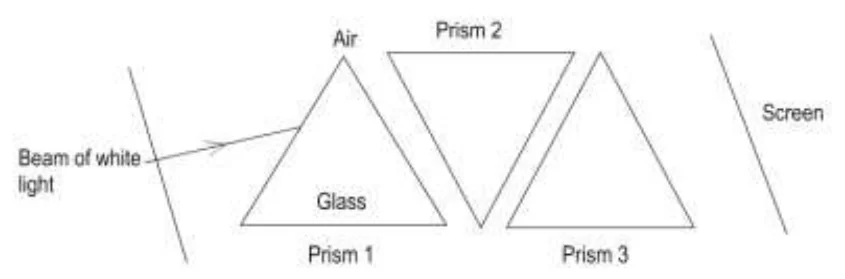
Savera passed a beam of white light through a series of equilateral prisms (Prism 1, 2, 3). (a) What colour(s) will be seen on the screen? (b) Copy the diagram and draw the beam entering Prism 1 and emerging from Prism 3 and falling on the screen. (c) Name all the processes that take place when the beam of light enters Prism 1 and emerges from Prism 3.

Beam of white light falling on Prism 1, followed by an inverted Prism 2 and Prism 3, with a screen beyond
Step-marked solution
  1. [1 mark] (a) Prism 1 disperses the white light into its seven constituent colours VIBGYOR (violet, indigo, blue, green, yellow, orange, red).
  2. [1 mark] (a) Prisms 2 and 3 (suitably inverted) recombine these colours, so the beam finally falling on the screen appears WHITE again (Newton's recombination experiment).
  3. [1 mark] (b) Diagram: the white beam enters Prism 1 and splits into the VIBGYOR spectrum.
  4. [1 mark] (b) Diagram: the spectrum passes through Prisms 2 and 3 and recombines into a single white beam falling on the screen.
  5. [1 mark] (c) Processes taking place: dispersion (splitting of white light), refraction (bending at each prism surface) and recombination of the colours.
5 marksSection D

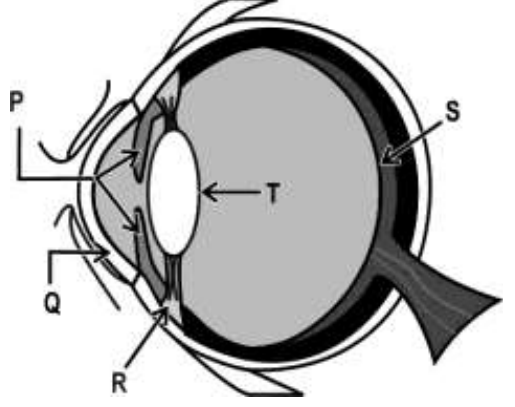
(a) Rupal suffers from myopia. Where would the image form in her eye? (b) Name the type of lens that is generally used to correct myopia. (c) Rupal underwent cataract surgery and her eye lens was replaced with an artificial lens with a fixed focal length, made of a plastic material, silicone. State one likely visual disadvantage that Rupal is likely to experience as compared to a person who has normal eyesight. (d) Identify the parts of the eye labeled (i)-(iv) in the diagram: (i) changes focal length of lens; (ii) causes most refraction; (iii) controls amount of light entering; (iv) acts as screen.

Figure from the question paper for: (a) Rupal suffers from myopia. Where would the image form in her eye? (b) Name the type of
Step-marked solution
  1. [1 mark] (a) In myopia (short-sightedness), the image of a distant object forms in FRONT of the retina (eye lens too convergent / eyeball too long).
  2. [1 mark] (b) A concave (diverging) lens of suitable negative power is used to correct myopia, shifting the image back onto the retina.
  3. [1 mark] (c) With a fixed-focal-length artificial lens she loses the power of accommodation — the lens cannot change shape to focus on both near and distant objects (unlike the natural lens controlled by ciliary muscles).
  4. [1 mark] (d) (i) ciliary muscle — changes the focal length of the eye lens; (ii) cornea — causes most (~80%) of the refraction.
  5. [1 mark] (d) (iii) iris/pupil — controls the amount of light entering the eye; (iv) retina — acts as the light-sensitive screen.
5 marksSection D

A person is unable to see objects distinctly placed within 75 cm from his eyes. (a) Name the defect of vision the person is suffering from. (b) List its two possible causes. (c) Calculate the power of the lens needed to correct this defect. Assume that the near point for the normal eye is 25 cm.

Step-marked solution
  1. [1 mark] (a) The defect is HYPERMETROPIA (long-sightedness) — the near point has moved away from the normal 25 cm.
  2. [1 mark] (b) Cause 1: the curvature of the eye lens decreases (eye lens becomes less convergent, focal length too long).
  3. [1 mark] (b) Cause 2: the eyeball becomes too short, so the image of a near object forms behind the retina.
  4. [1 mark] (c) To correct, an object at 25 cm must give a virtual image at the near point 75 cm: u = −25 cm, v = −75 cm. Lens formula 1/f = 1/v − 1/u = 1/(−75) − 1/(−25) = −1/75 + 3/75 = 2/75 ⟹ f = 37.5 cm = 0.375 m.
  5. [1 mark] (c) Power P = 1/f(in m) = 1/0.375 ≈ +2.67 D (positive ⟹ convex lens).
Practise The Human Eye and the Colourful World competency questions

Read NCERT Chapter 10 on LazyTopper (jesc110)

Official NCERT chapter PDF (jesc110) — ncert.nic.in

Sources: NCERT 2026-27 (tap to view)
Source ledger PROVENANCE

Source edition: NCERT Reprint 2026-27, Class 10 Science, Ch 10. One row per sourced item — every verbatim, example and NCERT figure traces to its page.

ItemTypeSource
Accommodation (power of accommodation)verbatimNCERT 2026-27 Ch10
Least distance of distinct vision (near point)verbatimNCERT 2026-27 Ch10
Myopia (near-sightedness)verbatimNCERT 2026-27 Ch10
Hypermetropia (far-sightedness)verbatimNCERT 2026-27 Ch10
PresbyopiaverbatimNCERT 2026-27 Ch10
Angle of deviation (through a prism)verbatimNCERT 2026-27 Ch10
Dispersion of lightverbatimNCERT 2026-27 Ch10
Far pointverbatimNCERT 2026-27 Ch10
IrisverbatimNCERT 2026-27 Ch10
CataractverbatimNCERT 2026-27 Ch10
SpectrumverbatimNCERT 2026-27 Ch10
Tyndall effectverbatimNCERT 2026-27 Ch10
Myopia — power of the correcting lensexampleNCERT 2026-27 Ch10 Exercise Q6
Hypermetropia — power of the correcting lensexampleNCERT 2026-27 Ch10 Exercise Q7
NCERT Fig 10.1figureNCERT 2026-27 Ch10 Fig 10.1
NCERT Fig 10.2figureNCERT 2026-27 Ch10 Fig 10.2
NCERT Fig 10.3figureNCERT 2026-27 Ch10 Fig 10.3
NCERT Fig 10.5figureNCERT 2026-27 Ch10 Fig 10.5

The Human Eye and the Colourful World · spec-rendered note · NCERT Reprint 2026-27, Class 10 Science, Ch 10

Practise writing answers the way examiners mark them → Guide