What the board actually asks:label-and-explain diagrams (the human digestive system, heart, nephron and respiratory system), the four life processes traced stage-by-stage, comparison tables (xylem vs phloem, aerobic vs anaerobic, arteries vs veins), and "why is it necessary" reasoning - one of the highest-weight Biology chapters.
Four processes keep a living body from falling apart - nutrition, respiration, transportation, excretion.
Every living body must take in food and energy, break it down to power its cells, move materials to where they are needed, and clear out the waste. In Class 10 these four life processes are examined mostly through labelled diagrams and stage-by-stage explanations, so most marks reward the exact NCERT terms and correctly drawn, correctly labelled structures.
Systolic about 120 mm Hg, diastolic about 80 mm Hg (measured with a sphygmomanometer)
Tip: Systolic ~120, diastolic ~80 mm Hg.
Alveolar surface
Spread out, the alveolar surface would cover about 80m2 - maximising gas exchange
Kidney filtrate
About 180 L of initial filtrate a day, but only 1-2 L excreted - the rest is re-absorbed
Photosynthesis: the Three Events
(i) Absorption of light energy by chlorophyll. (ii) Conversion of light energy into chemical energy, and splitting of water molecules into hydrogen and oxygen. (iii) Reduction of carbon dioxide to carbohydrates.
Stomata and Guard Cells
The tiny pores on a leaf are called stomata. Each pore is surrounded by two guard cells. The pore opens when the guard cells swell with water and closes when they shrink. Gases are exchanged, and water is lost, through the stomata.
Autotrophic and Heterotrophic Nutrition
Autotrophs (green plants and some bacteria) make their own food by photosynthesis. Heterotrophs depend directly or indirectly on autotrophs for their food.
Human Digestive System: Parts and Functions
Mouth: saliva from the salivary glands contains the enzyme salivary amylase, which breaks starch down into sugar. Oesophagus: carries food to the stomach. Stomach: releases hydrochloric acid (which makes the medium acidic), the protein-digesting enzyme pepsin and mucus (which protects the inner lining). Small intestine: the longest part, where digestion of carbohydrates, proteins and fats is completed with bile from the liver and pancreatic juice; its villi absorb the digested food. Large intestine: absorbs water from the unabsorbed food; the rest leaves through the anus.
Digestive Enzymes and What They Digest
Salivary amylase digests starch. Pepsin (in the stomach) digests proteins. Trypsin (from the pancreas) digests proteins and lipase (from the pancreas) breaks down emulsified fats. Bile from the liver is NOT an enzyme: bile salts break large fat globules into smaller ones (emulsification).
Aerobic and Anaerobic Respiration
Glucose is first broken down into pyruvate in the cytoplasm. Aerobic respiration (with oxygen, in the mitochondria): pyruvate breaks down into carbon dioxide, water and energy. Anaerobic respiration (without oxygen): in yeast, pyruvate becomes ethanol and carbon dioxide; in our muscle cells, it becomes lactic acid, whose build-up causes cramps.
Human Respiratory System and Alveoli
Air enters through the nostrils, where fine hairs and mucus filter it, and passes to the nasal passage, pharynx, larynx and trachea, whose rings of cartilage keep the passage open. Inside the lungs the passage divides into bronchi, bronchioles and finally balloon-like alveoli. The walls of the alveoli have a network of blood vessels where oxygen and carbon dioxide are exchanged. The diaphragm and ribs move to draw air in and push it out.
Path of Blood through the Heart
Deoxygenated blood from the body enters the right atrium, goes to the right ventricle and is pumped to the lungs. Oxygenated blood returns from the lungs to the left atrium, goes to the left ventricle and is pumped to the whole body.
Blood Components and Blood Vessels
Blood has plasma, red blood cells (the pigment haemoglobin carries oxygen) and platelets (which help blood to clot). It flows in arteries, veins and capillaries. Lymph, a fluid that leaks from the capillaries, carries digested fat and drains excess fluid back to the veins.
Transport in Plants: Xylem, Phloem, Transpiration
Xylem carries water and minerals from the soil upward. Water is lost from the leaves as vapour through the stomata (transpiration), which helps to pull water up. Phloem carries food made in the leaves to all parts of the plant (translocation), in both upward and downward directions.
Excretory System and Urine Formation
The excretory system has a pair of kidneys, a pair of ureters, a urinary bladder and a urethra. Each kidney contains many filtering units called nephrons. The filtrate collects in Bowman's capsule; useful substances are taken back (reabsorbed) and the rest forms urine, which flows through the ureter to the bladder and leaves through the urethra.
📖NCERT verbatim — memorise this exact wording· Ch 5,
“The processes which together perform this maintenance job are life processes.”
What it means:The basic functions - nutrition, respiration, transportation, excretion - that every living body runs continuously to stay organised and alive.
Nutrition
📖NCERT verbatim — memorise this exact wording· Ch 5,
“So there must be a process to transfer a source of energy from outside the body of the organism, which we call food, to the inside, a process we commonly call nutrition.”
What it means:Taking in food from outside to supply the body with energy and raw materials.
Autotrophic nutrition (photosynthesis)
📖NCERT verbatim — memorise this exact wording· Ch 5,
“Carbon and energy requirements of the autotrophic organism are fulfilled by photosynthesis. It is the process by which autotrophs take in substances from the outside and convert them into stored forms of energy.”
What it means:Green plants and some bacteria make their own food from CO2 and water using sunlight and chlorophyll.
Respiration
📖NCERT verbatim — memorise this exact wording· Ch 5,
“The process of acquiring oxygen from outside the body, and to use it in the process of break-down of food sources for cellular needs, is what we call respiration.”
What it means:Breaking down glucose (usually with oxygen) inside cells to release energy for life activities.
Transportation
📖NCERT verbatim — memorise this exact wording· Ch 5,
“This situation creates a need for a transportation system for carrying food and oxygen from one place to another in the body.”
What it means:The system (blood in animals, vascular tissue in plants) that moves food, oxygen and wastes between the parts that supply them and the parts that need them.
Excretion
📖NCERT verbatim — memorise this exact wording· Ch 5,
“The biological process involved in the removal of these harmful metabolic wastes from the body is called excretion.”
What it means:Getting rid of the poisonous nitrogenous wastes (like urea) that the body's chemical reactions produce.
📖Key terms — NCERT verbatim (state word-for-word)
Stomata
...stomata ... which are tiny pores present on the surface of the leaves. (Ch 5, )
Aerobic respiration
Since this process takes place in the presence of air (oxygen), it is called aerobic respiration. (Ch 5, )
Anaerobic respiration
Since this process takes place in the absence of air (oxygen), it is called anaerobic respiration. (Ch 5, )
Alveoli
balloon-like structures which are called alveoli (singular - alveolus). The alveoli provide a surface where the exchange of gases can take place. (Ch 5, )
Haemoglobin
In human beings, the respiratory pigment is haemoglobin which has a very high affinity for oxygen. (Ch 5, )
Xylem
One, the xylem moves water and minerals obtained from the soil. (Ch 5, )
Phloem
The other, phloem transports products of photosynthesis from the leaves where they are synthesised to other parts of the plant. (Ch 5, )
Nephrons
Each kidney has large numbers of these filtration units called nephrons packed close together. (Ch 5, )
Must-know concepts AUTHORED FRAMING
…and where they’re tested
1
Autotrophic vs heterotrophic nutrition
Autotrophs (green plants, some bacteria) build their own food from inorganic CO2 and water; heterotrophs (animals, fungi) take in the complex food made by others and break it down with enzymes.
3-mark: differentiate autotrophic and heterotrophic nutrition with examples.
2
Photosynthesis
In the leaf, chlorophyll in chloroplasts absorbs light; the three events are absorption of light energy, conversion to chemical energy plus splitting of water, and reduction of CO2 to carbohydrate. Raw materials: CO2 (through stomata), water (from roots) and sunlight.
NCERT Fig 5.1Cross-section of a leaf
Shows the leaf shape (midrib, lamina, vein with xylem/phloem bundle) and the cellular section (upper/lower epidermis, waxy cuticle, chloroplast, air spaces, guard cell) - the site of photosynthesis and gas exchange.
necessary conditions and by-products of autotrophic nutrition; role of stomata and guard cells.
3
Human digestive system
A long alimentary canal (mouth to oesophagus to stomach to small intestine to large intestine to anus) with region-specific enzymes; the small intestine is the site of complete digestion and its villi maximise absorption.
NCERT Fig 5.6Human alimentary canal
The full canal - mouth (buccal cavity), tongue, oesophagus, stomach, liver, gall bladder, bile duct, pancreas, small intestine, large intestine (colon), appendix, anus.
5-mark: label the human alimentary canal and name the enzymes and their functions; role of saliva / HCl / bile.
4
Respiration - aerobic vs anaerobic
Glucose (6 carbon) first splits to pyruvate (3 carbon) in the cytoplasm; then either aerobic (in mitochondria, giving CO2 + water and more energy) or anaerobic (yeast gives ethanol + CO2; muscle gives lactic acid, causing cramps).
differences between aerobic and anaerobic respiration with organisms; site of pyruvate breakdown.
5
Human circulatory system and double circulation
The four-chambered heart keeps oxygenated and de-oxygenated blood separate; blood (plasma plus cells) is pumped through arteries, capillaries and veins and passes through the heart twice per cycle.
NCERT Fig 5.10Schematic sectional view of the human heart
Four chambers with the vessels labelled - aorta, vena cava (upper/lower), pulmonary arteries and veins, left/right atrium, left/right ventricle, and the dividing septum. Pale-blue = de-oxygenated, peach = oxygenated.
5-mark: describe double circulation and why it is necessary; why oxygenated and de-oxygenated blood are separated in birds and mammals.
6
Transport in plants - xylem and phloem
Xylem carries water and minerals upward from the roots (root pressure plus transpiration pull); phloem translocates soluble food from the leaves in both directions, using energy from ATP.
differences between transport in xylem and phloem; how water and how food are transported in plants.
7
Excretion in humans - the nephron
Kidneys filter nitrogenous wastes (urea, uric acid); each nephron performs filtration in the Bowman's capsule then selective re-absorption along the tubule; urine passes through ureters to the bladder and out via the urethra.
NCERT Fig 5.14Structure of a nephron
The filtration unit - branch of renal artery/vein, glomerulus, Bowman's capsule, the tubular part, surrounding capillaries and the collecting duct.
5-mark: structure and functioning of the nephron; how the amount of urine is regulated; compare alveoli and nephron.
Worked examples — real solved problems NCERT VERBATIM
Solved exactly as the source does them
Every problem is a real sourced item, quoted verbatim with its page; the step-by-step decoding and mark-logic are LazyTopper-authored coaching.
Example Fig. 5.5 walkthrough,
“Trace how an Amoeba ingests and digests its food. [authored prompt]”
1
Ingestion.Amoeba takes in food using temporary finger-like extensions (pseudopodia) of the cell surface, which fuse over the food particle to form a food-vacuole.
1 mark
2
Digestion.Inside the food-vacuole, complex substances are broken down into simpler ones.
1 mark
3
Absorption.The simpler substances then diffuse into the cytoplasm.
4
Egestion.The remaining undigested material is moved to the surface of the cell and thrown out.
1 mark
Mark-scheme logic (authored):CBSE 3-mark - 1 mark each for pseudopodia/food-vacuole (ingestion), intracellular digestion, and egestion of undigested matter. Absorption (diffusion into the cytoplasm) is part of the process but is not a separately-credited step in the 3-mark scheme.
Example Fig. 5.6 walkthrough,
“Trace how food is digested as it passes mouth to stomach to small intestine. [authored prompt]”
Example Fig. 5.9 walkthrough,
“Explain how gases are exchanged in the human lungs during breathing. [authored prompt]”
Example Figs. 5.10-5.11 walkthrough,
“Trace the path of blood through the four chambers of the human heart. [authored prompt]”
Example Fig. 5.12 walkthrough,
“Explain how water rises from the roots to the top of a tall plant. [authored prompt]”
Example Figs. 5.13-5.14 walkthrough,
“Describe how urine is formed in the nephron. [authored prompt]”
Problem-solving strategies AUTHORED
→
Diagram question?Draw it large, label with straight ruled lines, and use exact NCERT terms - write "oesophagus" not "food pipe", "alveoli" not "air sacs".
→
"Differences between" asked?Answer in a two-column table (xylem vs phloem, aerobic vs anaerobic, arteries vs veins) - one clear point per row scores faster than a paragraph.
→
Enzyme / organ question?Pair every organ with its secretion and function - saliva to amylase to starch, stomach to pepsin + HCl to protein, pancreas to trypsin/lipase - examiners award the enzyme name AND its substrate separately.
→
"Why is it necessary?" add-on?Board answers want the reason, not just the process - e.g. double circulation is needed to stop oxygenated and de-oxygenated blood mixing, giving an efficient O2 supply for high energy needs.
Common mistakes that cost marks
Where students lose easy marks
✕
Writing "food pipe" instead of oesophagus, or "wind pipe / air sacs" instead of trachea / alveoli - CBSE demands the exact technical term.
✕
Confusing xylem and phloem: xylem = water + minerals, roots upward (one-way); phloem = food, both directions. Reversing them loses the whole mark.
✕
Mislabelling heart chambers - putting oxygenated blood on the right, or swapping atria and ventricles. Remember: LEFT side = oxygen-rich, and ventricles have thicker walls than atria.
✕
Saying anaerobic respiration in muscles gives ethanol - in human muscle cells pyruvate becomes lactic acid (ethanol + CO2 is only in yeast/fermentation).
✕
Describing filtration only and forgetting that in the nephron useful substances (glucose, amino acids, salts, water) are RE-ABSORBED.
Systolic about 120 mm Hg, diastolic about 80 mm Hg (measured with a sphygmomanometer)
Tip: Systolic ~120, diastolic ~80 mm Hg.
Alveolar surface
Spread out, the alveolar surface would cover about 80m2 - maximising gas exchange
Kidney filtrate
About 180 L of initial filtrate a day, but only 1-2 L excreted - the rest is re-absorbed
Photosynthesis: the Three Events
(i) Absorption of light energy by chlorophyll. (ii) Conversion of light energy into chemical energy, and splitting of water molecules into hydrogen and oxygen. (iii) Reduction of carbon dioxide to carbohydrates.
Stomata and Guard Cells
The tiny pores on a leaf are called stomata. Each pore is surrounded by two guard cells. The pore opens when the guard cells swell with water and closes when they shrink. Gases are exchanged, and water is lost, through the stomata.
Autotrophic and Heterotrophic Nutrition
Autotrophs (green plants and some bacteria) make their own food by photosynthesis. Heterotrophs depend directly or indirectly on autotrophs for their food.
Human Digestive System: Parts and Functions
Mouth: saliva from the salivary glands contains the enzyme salivary amylase, which breaks starch down into sugar. Oesophagus: carries food to the stomach. Stomach: releases hydrochloric acid (which makes the medium acidic), the protein-digesting enzyme pepsin and mucus (which protects the inner lining). Small intestine: the longest part, where digestion of carbohydrates, proteins and fats is completed with bile from the liver and pancreatic juice; its villi absorb the digested food. Large intestine: absorbs water from the unabsorbed food; the rest leaves through the anus.
Digestive Enzymes and What They Digest
Salivary amylase digests starch. Pepsin (in the stomach) digests proteins. Trypsin (from the pancreas) digests proteins and lipase (from the pancreas) breaks down emulsified fats. Bile from the liver is NOT an enzyme: bile salts break large fat globules into smaller ones (emulsification).
Aerobic and Anaerobic Respiration
Glucose is first broken down into pyruvate in the cytoplasm. Aerobic respiration (with oxygen, in the mitochondria): pyruvate breaks down into carbon dioxide, water and energy. Anaerobic respiration (without oxygen): in yeast, pyruvate becomes ethanol and carbon dioxide; in our muscle cells, it becomes lactic acid, whose build-up causes cramps.
Human Respiratory System and Alveoli
Air enters through the nostrils, where fine hairs and mucus filter it, and passes to the nasal passage, pharynx, larynx and trachea, whose rings of cartilage keep the passage open. Inside the lungs the passage divides into bronchi, bronchioles and finally balloon-like alveoli. The walls of the alveoli have a network of blood vessels where oxygen and carbon dioxide are exchanged. The diaphragm and ribs move to draw air in and push it out.
Path of Blood through the Heart
Deoxygenated blood from the body enters the right atrium, goes to the right ventricle and is pumped to the lungs. Oxygenated blood returns from the lungs to the left atrium, goes to the left ventricle and is pumped to the whole body.
Blood Components and Blood Vessels
Blood has plasma, red blood cells (the pigment haemoglobin carries oxygen) and platelets (which help blood to clot). It flows in arteries, veins and capillaries. Lymph, a fluid that leaks from the capillaries, carries digested fat and drains excess fluid back to the veins.
Transport in Plants: Xylem, Phloem, Transpiration
Xylem carries water and minerals from the soil upward. Water is lost from the leaves as vapour through the stomata (transpiration), which helps to pull water up. Phloem carries food made in the leaves to all parts of the plant (translocation), in both upward and downward directions.
Excretory System and Urine Formation
The excretory system has a pair of kidneys, a pair of ureters, a urinary bladder and a urethra. Each kidney contains many filtering units called nephrons. The filtrate collects in Bowman's capsule; useful substances are taken back (reabsorbed) and the rest forms urine, which flows through the ureter to the bladder and leaves through the urethra.
Shortcuts & Tricks
In diagram answers label every part the question names and add a title; labels are marked separately.
Transport tissues. xylem: water and minerals, upward · phloem: food, both directions.
Mindmap
Autotrophic - photosynthesis (CO2 + water + sunlight + chlorophyll)
Heterotrophic - animals & fungi; enzymes break down complex food
Human digestion - mouth to stomach to small intestine; villi absorb
Amoeba - pseudopodia + food-vacuole
Glucose to pyruvate (cytoplasm)
Aerobic (mitochondria) to CO2 + water + more energy
Anaerobic - yeast to ethanol + CO2; muscle to lactic acid
Energy stored as ATP
Human - 4-chambered heart, double circulation
Blood vessels - arteries, veins, capillaries
Plants - xylem (water, up) & phloem (food, both ways)
Transpiration pull + root pressure
Human - kidney, nephron (filtration + re-absorption)
Path - ureter to bladder to urethra
Plants - waste in vacuoles, resins/gums, falling leaves
Use NCERT terms - oesophagus, alveoli, not slang
Xylem vs phloem direction
Correct heart-chamber labels
Nephron = filtration + RE-ABSORPTION
The diagrams you must be able to draw and label - Life Processes is examined heavily through labelled figures. Learn each one in the exact NCERT form.
Structure of a Leaf: Guard Cells and Stomata
NCERT Fig 5.1Cross-section of a leaf
Shows the leaf shape (midrib, lamina, vein with xylem/phloem bundle) and the cellular section (upper/lower epidermis, waxy cuticle, chloroplast, air spaces, guard cell) - the site of photosynthesis and gas exchange.
NCERT Fig 5.5Nutrition in Amoeba
Stages (a)-(d): pseudopodia engulf the food particle into a food-vacuole, then intracellular digestion and egestion. Labels: nucleus, food particle, pseudopodia, food vacuole.
Human Digestive System Diagram
NCERT Fig 5.6Human alimentary canal
The full canal - mouth (buccal cavity), tongue, oesophagus, stomach, liver, gall bladder, bile duct, pancreas, small intestine, large intestine (colon), appendix, anus.
Human Respiratory System and Alveoli
NCERT Fig 5.9Human respiratory system
Torso view with the alveoli inset - nasal passage, throat, bronchi, lungs, diaphragm, and the balloon-like alveoli where gas exchange occurs.
Human Heart Diagram
NCERT Fig 5.10Schematic sectional view of the human heart
Four chambers with the vessels labelled - aorta, vena cava (upper/lower), pulmonary arteries and veins, left/right atrium, left/right ventricle, and the dividing septum. Pale-blue = de-oxygenated, peach = oxygenated.
NCERT Fig 5.13Excretory system in human beings
The pair of kidneys with the vena cava and aorta, the ureters carrying urine to the urinary bladder, and the urethra.
Structure of a Nephron
NCERT Fig 5.14Structure of a nephron
The filtration unit - branch of renal artery/vein, glomerulus, Bowman's capsule, the tubular part, surrounding capillaries and the collecting duct.
3 competency questions from the CBSE board pattern, with the full step-marked solution for each — the marks are shown per step, as the official scheme awards them.
1 markSection A
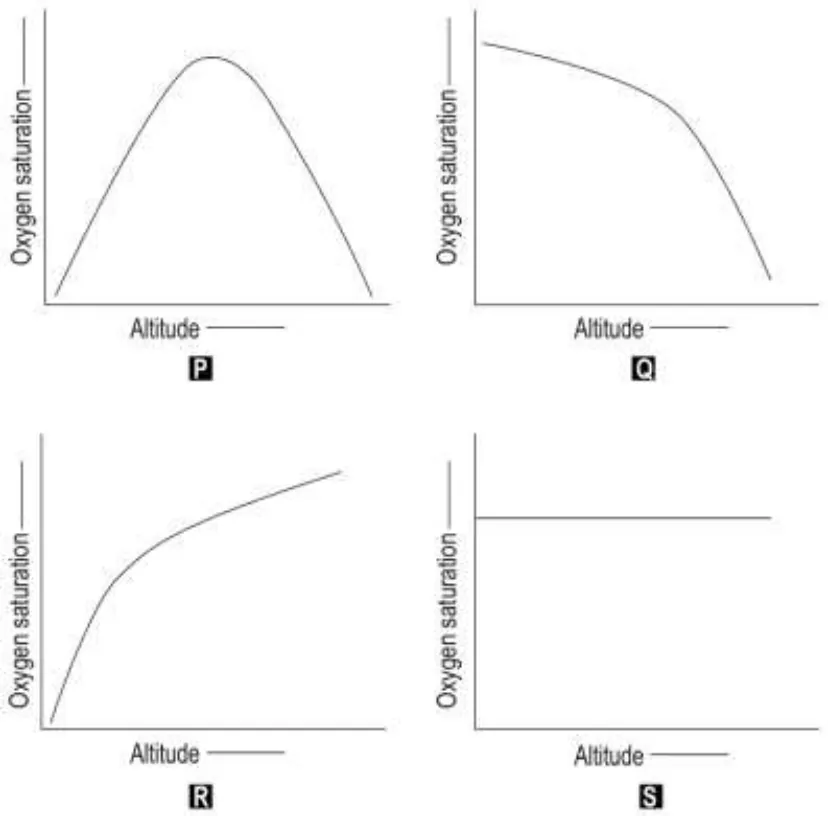
Oxygen saturation levels refer to the extent haemoglobin is bound to oxygen. As altitude increases, the atmospheric pressure decreases. Which of the following graphs correctly represents the oxygen saturation levels as altitude increases?
(A) P
(B) Q
(C) R
(D) S
Step-marked solution
[1 mark] At higher altitude, atmospheric pressure (and pO2) is lower ⟹ less O2 binds to haemoglobin ⟹ O2 saturation decreases as altitude increases. Graph Q shows a decreasing trend matching this physiology.
1 markSection A
Patient X was suffering from a pancreatic condition due to which the pancreas was not functioning adequately. Which of the following is a doctor likely to suggest to such an individual?
(A) including a large amount of protein in the diet
(B) eating a diet with low-fat content
(C) eating only carbohydrates
(D) including only liquid foods
Step-marked solution
[1 mark] Pancreas secretes lipase (digests fats) along with amylase, trypsin. If pancreas malfunctions, fat digestion is impaired ⟹ low-fat diet recommended.
2 marksSection B
A plant X was enclosed in a glass jar with some lizards. A similar plant Y was enclosed in another glass jar but without lizards. Both jars are kept under the same light conditions for a few hours. Which plant is likely to photosynthesize more and why?
Step-marked solution
[1 mark] Lizards respire and release CO2 inside the jar, increasing CO2 concentration around plant X.
[1 mark] Higher CO2 availability + adequate light ⟹ higher rate of photosynthesis in X compared to Y (which has limited CO2 in the closed jar).