Polynomials Topic Hub

Polynomials — Class 10 Notes

CBSE 2027 — dates, rules and official papers →
Maths · Ch 2Class 10 · CBSE 2026–27Medium weightage

Polynomials

What the board actually asks: finding the zeroes of a quadratic polynomial and verifying the sum/product relationship with its coefficients, reading the number of zeroes off a graph (the geometrical meaning), and forming a quadratic from a given sum and product of zeroes.

NCERT VERBATIM sourced, word-for-wordAUTHORED LazyTopper teaching scaffolding
The Big Idea AUTHORED

Zeroes are where the graph lands on the x-axis.

A polynomial's zeroes are the values of that make it - and geometrically, they are exactly the points where the graph crosses the -axis. This short chapter ties three views of one idea together: the algebra (factorise to find the zeroes), the geometry (count the -axis crossings), and the coefficients (for a quadratic, and ). Master the quadratic case - that is what the board assesses.

Formulae
Quadratic polynomial
Tip: Degree 2; if a = 0 it is not quadratic.
Zero
Tip: A zero is the x-coordinate of the point where the graph meets the x-axis.
Sum of zeroes
Tip: α+β = −b/a: the sign flips against the x-coefficient.
Product of zeroes
Tip: αβ = c/a.
Build from zeroes
Tip: Write "x² − (α+β)x + αβ" and say any non-zero multiple also works.
Zeroes of a Quadratic from its Graph
The graph of a quadratic polynomial is a parabola. If it cuts the x-axis twice there are 2 zeroes; if it just touches the x-axis there is 1 (repeated) zero; if it never meets the x-axis there is no real zero. The parabola opens upwards if and downwards if . A quadratic polynomial has at most 2 zeroes.
Expressions in and
· ·
Verifying the Relationship
Find the zeroes, then check that their sum equals and their product equals .
Definitions the board rewards NCERT VERBATIM

State these in NCERT’s exact words

Degree of a polynomial
NCERT verbatim — memorise this exact wording· Ch 2,
“Recall that if p(x) is a polynomial in x, the highest power of x in p(x) is called the degree of the polynomial p(x).”
What it means: the highest power of the variable. has degree 1; has degree 2. Degree tells you the polynomial's family - and caps how many zeroes it can have.
Quadratic polynomial
NCERT verbatim — memorise this exact wording· Ch 2,
“More generally, any quadratic polynomial in x is of the form ax2 + bx + c, where a, b, c are real numbers and a ≠ 0.”
What it means: a degree-2 polynomial, with . This is the case the whole chapter (and the board) focuses on.
Zero of a polynomial
NCERT verbatim — memorise this exact wording· Ch 2,
“More generally, a real number k is said to be a zero of a polynomial p(x), if p(k) = 0.”
What it means: a value of that makes the polynomial equal . Same idea as a root of the equation . Note: a zero is not the value .
Geometrical meaning of the zeroes
NCERT verbatim — memorise this exact wording· Ch 2,
“the zeroes of a quadratic polynomial ax2 + bx + c, a ≠ 0, are precisely the x-coordinates of the points where the parabola representing y = ax2 + bx + c intersects the x-axis.”
What it means: draw and look at where it meets the -axis - each crossing is a zero. This is why the number of zeroes can be read straight off a graph.
Key terms — NCERT verbatim (state word-for-word)
Value p(k)
If p(x) is a polynomial in x, and if k is any real number, then the value obtained by replacing x by k in p(x), is called the value of p(x) at x = k, and is denoted by p(k). (Ch 2, )
Linear polynomial
A polynomial of degree 1 is called a linear polynomial. (Ch 2, )
Cubic polynomial
A polynomial of degree 3 is called a cubic polynomial. (Ch 2, )
Must-know concepts AUTHORED FRAMING

…and where they’re tested

Zeroes of a polynomial
A zero of is any value with - substitute it and the polynomial collapses to . For a quadratic, factorise into two linear factors and set each to zero; the two values you get are the zeroes.
NCERT Fig 2.2Graph of y = x^2 - 3x - 4 · the curve cuts the x-axis at x = -1 and x = 4 - its two zeroes.
The two x-axis crossings, (-1, 0) and (4, 0), are exactly the zeroes of the polynomial.
1-mark 'is a zero of ?' and 2-mark 'find the zeroes'.
Geometrical meaning - zeroes are x-axis crossings
The zeroes of are exactly the -coordinates where the graph crosses the -axis. A parabola can meet the axis at two points (two distinct zeroes), touch it at one point (two equal zeroes), or miss it entirely (no zero).
Figurey = p(x) - the zeroes are where the parabola meets the x-axis
two zeroes
cuts at x = -1 and x = 4 (NCERT's y = x^2 - 3x - 4)
one point
touches at x = 2 (two equal zeroes)
no zero
stays above the x-axis
Left: two distinct zeroes (cuts twice) · Middle: two equal zeroes (just touches) · Right: no real zero (never meets).
1-mark MCQ 'number of zeroes from the graph' (Exercise 2.1 style).
A quadratic has at most two zeroes
Degree bounds the count: the graph of a degree- polynomial meets the -axis at most times, so a quadratic has at most two zeroes and a linear polynomial has exactly one.
Reasoning / MCQ on the maximum number of zeroes.
Zeroes and coefficients (quadratic)
For zeroes of : (sum) and (product). This lets you verify computed zeroes without solving again.
2-3 mark 'find the zeroes and verify the relationship' - the chapter's staple.
Building a quadratic from its zeroes
Given the sum and product of the zeroes, a quadratic is (and any real multiple of it also works). So sum , product gives .
2-3 mark 'form the quadratic polynomial'.
Worked examples — real solved problems NCERT VERBATIM

Solved exactly as the source does them

Every problem is a real sourced item, quoted verbatim with its page; the step-by-step decoding and mark-logic are LazyTopper-authored coaching.

Ch 2, Example 2,
“Find the zeroes of the quadratic polynomial x2 + 7x + 10, and verify the relationship between the zeroes and the coefficients.”
Factorise..Concept: factorise into two linear factors
1 mark
Set each factor to zero. when or , i.e. or . So the zeroes are and .Concept: read off both zeroes
1 mark
Verify sum and product.Sum ; product .Concept: check against the coefficients
1 mark
Mark-scheme logic (authored): 3-mark shape: 1 for the factorisation, 1 for stating BOTH zeroes, 1 for verifying sum and product . The verification is explicitly asked - skip it and the last mark is gone.
Ch 2, Example 3,
“Find the zeroes of the polynomial x2 – 3 and verify the relationship between the zeroes and the coefficients.”
Ch 2, Example 4,
“Find a quadratic polynomial, the sum and product of whose zeroes are – 3 and 2, respectively.”
Ch 2,
“Find the zeroes of the following quadratic polynomials and verify the relationship between the zeroes and the coefficients. (i) x2 – 2x – 8”
Problem-solving strategies AUTHORED
'Find the zeroes'?Factorise the quadratic into two linear factors, set each to zero, and read off BOTH zeroes.
'...and verify the relationship'?Check and - it is a separate mark, never skip it.
'Form a quadratic with these zeroes'?Use ; add that any real -multiple also fits.
Graph given, 'how many zeroes'?Count the points where the curve crosses the -axis - that is the number of zeroes.
'Is a zero of ?'Compute ; it is a zero exactly when .
Common mistakes that cost marks

Where students lose easy marks

Giving only one zero of a quadratic - always solve both linear factors and state both values.
Sign slip in the sum: carries a minus; the product does not.
Confusing a 'zero' with - a zero is where , not where .
Counting a touch-point as two crossings - when the parabola just touches the axis, that is two equal zeroes (one point), not two distinct ones.
Formulae
Quadratic polynomial
Tip: Degree 2; if a = 0 it is not quadratic.
Zero
Tip: A zero is the x-coordinate of the point where the graph meets the x-axis.
Sum of zeroes
Tip: α+β = −b/a: the sign flips against the x-coefficient.
Product of zeroes
Tip: αβ = c/a.
Build from zeroes
Tip: Write "x² − (α+β)x + αβ" and say any non-zero multiple also works.
Zeroes of a Quadratic from its Graph
The graph of a quadratic polynomial is a parabola. If it cuts the x-axis twice there are 2 zeroes; if it just touches the x-axis there is 1 (repeated) zero; if it never meets the x-axis there is no real zero. The parabola opens upwards if and downwards if . A quadratic polynomial has at most 2 zeroes.
Expressions in and
· ·
Verifying the Relationship
Find the zeroes, then check that their sum equals and their product equals .
Shortcuts & Tricks
If the zeroes are negatives of each other (α+β = 0) the x-term is missing (b = 0).
MCQ / check only: don't write this as working
Zeroes reciprocal of each other ⇔ αβ = 1 ⇔ c = a.
MCQ / check only: don't write this as working
1/α + 1/β = −b/c (c ≠ 0).
MCQ / check only: don't write this as working
Show the line α²+β² = (α+β)² − 2αβ, then substitute.
Safe in written answers
Count x-axis crossings; a touch means equal zeroes.
MCQ / check only: don't write this as working
Memory Tricks
Jod = minus Bhai upon Aloo. Gunaa = Chacha upon Aloo.
Sum = −b/a, product = c/a. Jod = sum, Gunaa = product; Bhai = b, Aloo = a, Chacha = c; minus applies to the sum only.
Do baar kate = do zero · ek baar chhue = ek zero (do barabar) · kabhi na mile = real zero nahi.
Parabola cases. 2 crossings = 2 zeroes; touch = 1 repeated zero; no meet = none.
x² minus (Jod)x plus Gunaa.
x² − (α+β)x + αβ. minus goes with the sum, plus with the product.
Mindmap
      • p(k) = 0 makes k a zero
      • Factorise, then set each factor to 0
      • Linear: one zero; quadratic: at most two
      • Zeroes = x-axis crossings of y = p(x)
      • Two points to two distinct zeroes
      • Touches to two equal zeroes
      • Misses to no zero
      • Sum = -b/a
      • Product = c/a
      • Verify computed zeroes
      • Any real k-multiple also works
      • Give BOTH zeroes
      • Minus sign in the sum
      • A 'zero' is not p(0)

Zeroes & coefficients of a quadratic - why sum = -b/a and product = c/a

The relationship you use to verify zeroes is not a rule to memorise blindly - NCERT derives it by writing the quadratic in terms of its factors and comparing coefficients. The 2026-27 syllabus keeps this QUADRATIC relationship (the cubic version is out of scope).

If and are the zeroes of , then and are its factors.
So is a constant times the product of those factors.
Expand the right-hand side.
Compare the coefficients of , of , and the constant term on both sides.
Divide through by to isolate the sum and product.
b/a and c/a fall straight out - this is exactly the relationship used to verify a pair of zeroes.

3 competency questions from the CBSE board pattern, with the full step-marked solution for each — the marks are shown per step, as the official scheme awards them.

1 markSection A

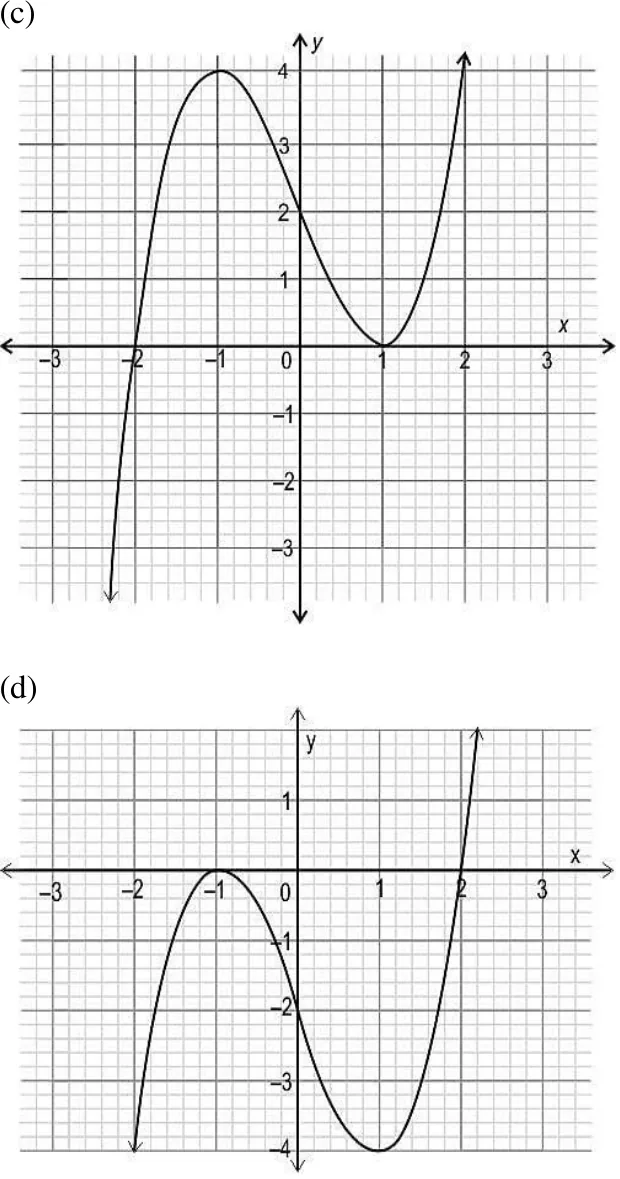
Which of the following could be the graph of the polynomial (x − 1)^2(x + 2)?
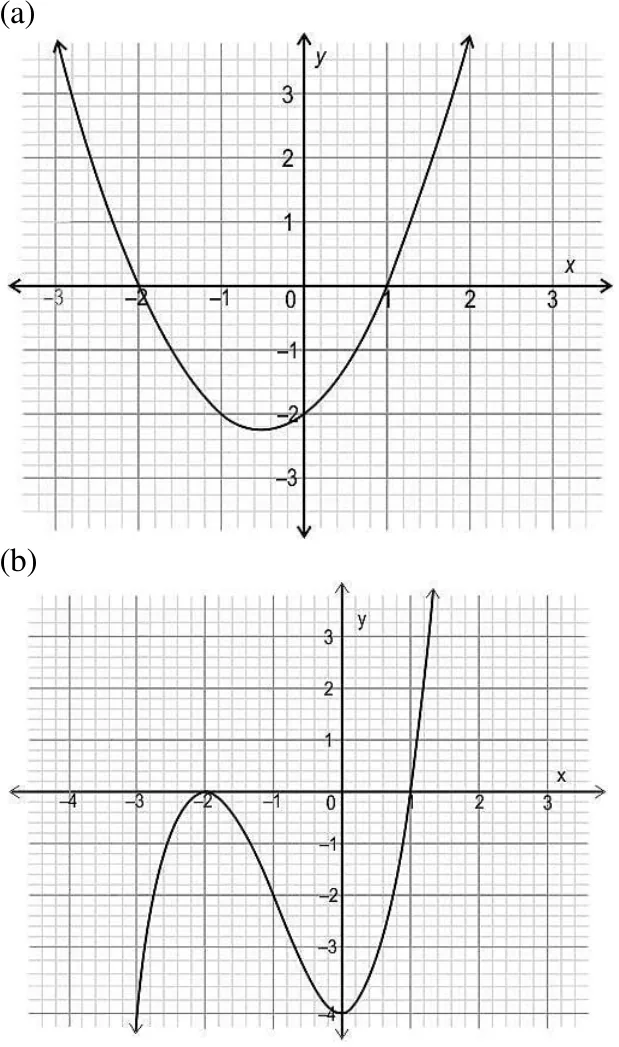
Option graphs (a) and (b): two polynomial curves drawn on x-y axes, each meeting the x-axis
Option graphs (c) and (d): two polynomial curves drawn on x-y axes, each meeting the x-axis
  1. (A) Graph (a)
  2. (B) Graph (b)
  3. (C) Graph (c)
  4. (D) Graph (d)
Step-marked solution
  1. [1 mark] Zeroes of (x − 1)²(x + 2) are x = 1 (repeated, so the graph touches the x-axis there without crossing) and x = −2 (crosses the x-axis); p(0) = (1)(2) = 2. Graph (a) crosses at both −2 and 1, graphs (b) and (d) touch the x-axis at a negative x and do not pass through (0, 2). Graph (c) crosses at −2, touches at 1 and passes through (0, 2), so it is the graph of the polynomial.
5 marksSection D

One condition on the zeroes α and β of p(x) = x² − 6x + k is that the sum of their squares (α² + β²) equals 20. Determine the value of k, then obtain the two zeroes.

Step-marked solution
  1. [1 mark] For x² − 6x + k: sum of zeroes α + β = −(−6)/1 = 6 and product αβ = k/1 = k.
  2. [1 mark] Use the identity α² + β² = (α + β)² − 2αβ = 36 − 2k.
  3. [1 mark] Apply the given condition: 36 − 2k = 20.
  4. [1 mark] Solve: 2k = 16 ⇒ k = 8.
  5. [1 mark] Then p(x) = x² − 6x + 8 = (x − 2)(x − 4), zeroes 2 and 4; check 2² + 4² = 4 + 16 = 20. ✓
5 marksSection D

For p(x) = x² − 8x + k with zeroes α and β, the sum of the reciprocals of the zeroes, 1/α + 1/β, comes to 2/3. Work out k and list both zeroes.

Step-marked solution
  1. [1 mark] For x² − 8x + k: α + β = 8 and αβ = k.
  2. [1 mark] Express the condition: 1/α + 1/β = (α + β)/(αβ) = 8/k.
  3. [1 mark] So 8/k = 2/3.
  4. [1 mark] Cross-multiply: 2k = 24 ⇒ k = 12.
  5. [1 mark] Then p(x) = x² − 8x + 12 = (x − 2)(x − 6), zeroes 2 and 6; check 1/2 + 1/6 = 2/3. ✓
Practise Polynomials competency questions

Read NCERT Chapter 2 on LazyTopper (jemh102)

Official NCERT chapter PDF (jemh102) — ncert.nic.in

Sources: NCERT 2026-27 (tap to view)
Source ledger PROVENANCE

Source edition: NCERT Reprint 2026-27, Class 10 Mathematics, Ch 2 (jemh102.pdf, printed pages 10-23). One row per sourced item — every verbatim, example and NCERT figure traces to its page.

ItemTypeSource
Degree of a polynomialverbatimNCERT 2026-27 Ch2
Quadratic polynomialverbatimNCERT 2026-27 Ch2
Zero of a polynomialverbatimNCERT 2026-27 Ch2
Geometrical meaning of the zeroesverbatimNCERT 2026-27 Ch2
Value p(k)verbatimNCERT 2026-27 Ch2
Linear polynomialverbatimNCERT 2026-27 Ch2
Cubic polynomialverbatimNCERT 2026-27 Ch2
Find zeroes + verify · NCERT Example 2exampleNCERT 2026-27 Ch2 Example 2
Irrational zeroes · NCERT Example 3exampleNCERT 2026-27 Ch2 Example 3
Form a quadratic · NCERT Example 4exampleNCERT 2026-27 Ch2 Example 4
Find zeroes + verify · NCERT Exercise 2.2 Q1(i)exampleNCERT 2026-27 Ch2 Exercise 2.2 Q1(i)
NCERT Fig 2.2 (graph of y = x^2 - 3x - 4)ncert-figureNCERT 2026-27 Ch2 Fig 2.2 (jemh102 pdf idx 3)

Polynomials · spec-rendered note · NCERT Reprint 2026-27, Class 10 Mathematics, Ch 2 (jemh102.pdf, printed pages 10-23)

Practise writing answers the way examiners mark them → Guide