Triangles Topic Hub

Triangles — Class 10 Notes

CBSE 2027 — dates, rules and official papers →
Maths · Ch 6Class 10 · CBSE 2026–27High weightage

Triangles

What the board actually asks: the three similarity criteria (AAA/AA, SSS, SAS), the Basic Proportionality Theorem (Thales) and its converse, and similar-triangle applications (heights, shadows, distances) - plus the ONE proof CBSE can ask you to write here: Theorem 6.1 (BPT). The rationalised 2026-27 chapter stops at the SAS criterion - areas of similar triangles and the Pythagoras proofs are no longer in this chapter.

NCERT VERBATIM sourced, word-for-wordAUTHORED LazyTopper teaching scaffolding
The Big Idea AUTHORED

Same shape, any size.

Two figures are similar when they have the same shape but not necessarily the same size - one is a scaled copy of the other. For triangles this means equal corresponding angles and proportional corresponding sides. The chapter gives you shortcuts (the AAA, SSS and SAS criteria) to decide similarity from just three facts, the Basic Proportionality Theorem to split sides in ratio, and a way to measure the unmeasurable - heights of towers and lengths of shadows - by comparing similar triangles.

Formulae

Basic Proportionality Theorem

Basic Proportionality Theorem
Tip: AD/DB = AE/EC. For AD/AB use the similar-triangles form.
Similar triangles - sides
Tip: Write the similarity in vertex order so the ratios read off directly.
Similar triangles - angles
Tip: Corresponding angles are equal.
Criteria
AAA / AA SSS SAS (included angle)
Tip: SAS needs the INCLUDED angle; AA needs only two angles.
Basic Proportionality Theorem: Statement
If a line is drawn parallel to one side of a triangle to intersect the other two sides in distinct points, the other two sides are divided in the same ratio. The proof is in the Proof tab.
DE ∥ BC: AD/AB = AE/AC = DE/BC
If then (AA), so .
Shadow and Pole Problems
At the same time of day, a pole and its shadow form a triangle similar to the one formed by a tower and its shadow (AA: both are right-angled and the Sun's angle of elevation is the same). So the heights are in the same ratio as the shadows.

Converse of the Basic Proportionality Theorem

Statement
If a line divides two sides of a triangle in the same ratio, the line is parallel to the third side. This is stated without proof. Use it to show that a line is parallel: for example, if .
Definitions the board rewards NCERT VERBATIM

State these in NCERT’s exact words

Similar figures
NCERT verbatim — memorise this exact wording· Ch 6,
“Two figures having the same shape but not necessarily the same size are called similar figures.”
What it means: same shape, any size. Every pair of congruent figures is automatically similar, but similar figures need not be congruent (a small photo and its enlargement are similar, not congruent).
Similar polygons
NCERT verbatim — memorise this exact wording· Ch 6,
“Two polygons of the same number of sides are similar, if (i) their corresponding angles are equal and (ii) their corresponding sides are in the same ratio (or proportion).”
What it means: for polygons you need BOTH conditions: every corresponding angle equal AND every corresponding side in the same ratio. Either one alone is not enough (a square and a rectangle share angles but not ratios; a square and a rhombus share ratios but not angles).
Similar triangles
NCERT verbatim — memorise this exact wording· Ch 6,
“Two triangles are similar, if (i) their corresponding angles are equal and (ii) their corresponding sides are in the same ratio (or proportion).”
What it means: the same two conditions as polygons - but for triangles, verifying ONE of them automatically forces the other. That is exactly what the AAA/SSS/SAS criteria below exploit, so you never have to check all six pairs.
Basic Proportionality Theorem (Theorem 6.1)
NCERT verbatim — memorise this exact wording· Ch 6,
“Theorem 6.1 : If a line is drawn parallel to one side of a triangle to intersect the other two sides in distinct points, the other two sides are divided in the same ratio.”
What it means: the Thales Theorem: a line parallel to one side of a triangle cuts the other two sides proportionally, . This is the ONE theorem in this chapter CBSE can ask you to PROVE - see the Proof tab.
AAA (Angle-Angle-Angle) similarity criterion (Theorem 6.3)
NCERT verbatim — memorise this exact wording· Ch 6,
“Theorem 6.3 : If in two triangles, corresponding angles are equal, then their corresponding sides are in the same ratio (or proportion) and hence the two triangles are similar.”
What it means: equal angles proportional sides similar. Since a triangle's third angle is fixed once two are known, two equal pairs of angles are already enough - that shorter form is the AA criterion.
SAS (Side-Angle-Side) similarity criterion (Theorem 6.5)
NCERT verbatim — memorise this exact wording· Ch 6,
“Theorem 6.5 : If one angle of a triangle is equal to one angle of the other triangle and the sides including these angles are proportional, then the two triangles are similar.”
What it means: one equal angle that sits BETWEEN two pairs of sides in the same ratio similar. The equal angle must be the included angle - the one between the two proportional sides.
Key terms — NCERT verbatim (state word-for-word)
Scale factor
Note that the same ratio of the corresponding sides is referred to as the scale factor (or the Representative Fraction) for the polygons. (Ch 6, )
Converse of BPT (Theorem 6.2)
Theorem 6.2 : If a line divides any two sides of a triangle in the same ratio, then the line is parallel to the third side. (Ch 6, )
SSS (Side-Side-Side) similarity criterion (Theorem 6.4)
If in two triangles, corresponding sides are in the same ratio, then their corresponding angles are equal and hence the triangles are similar. (Ch 6, )
AA similarity criterion
If two angles of one triangle are respectively equal to two angles of another triangle, then the two triangles are similar. (Ch 6, )
Must-know concepts AUTHORED FRAMING

…and where they’re tested

Similar vs congruent - same shape, any size
Congruent figures match in shape AND size; similar figures match in shape only. So all congruent figures are similar, but the converse is not true. All circles are similar, all squares are similar, all equilateral triangles are similar - because their shape is fixed.
1-mark fill-in-the-blank / MCQ (Exercise 6.1 style)
The two similarity conditions (and why triangles are special)
For any pair of polygons, similarity needs BOTH equal corresponding angles AND proportional corresponding sides. For triangles only, one condition automatically brings the other - which is why the three criteria each need just three facts. When you write the similarity, match vertices in order: means , , .
NCERT Fig. 6.22Similar triangles: △ABC ~ △DEF - equal corresponding angles (matching arc marks), proportional corresponding sides.
Single arc at A/D, double at B/E, triple at C/F mark the equal corresponding angles; the two triangles are the same shape at different sizes.
State the criterion + write the similarity in correct vertex order (Exercise 6.3 Q1)
Basic Proportionality Theorem (Thales) and its converse
BPT (Theorem 6.1): a line parallel to one side divides the other two sides in the same ratio, . Its converse (Theorem 6.2) runs backwards: if a line divides two sides in the same ratio, it must be parallel to the third side. Use BPT to find a missing length; use the converse to prove two lines parallel.
2-3 mark find EC/AD when DE || BC; prove a line is parallel (Exercise 6.2)
Picking a criterion - AAA/AA, SSS, SAS
AA: two pairs of equal angles. SSS: all three pairs of sides in the same ratio. SAS: one pair of equal angles with the two including sides in the same ratio. Scan the figure for what you are given - equal angles (from parallels, vertically opposite, or common angles) point to AA; three known side-ratios point to SSS.
State which pairs of triangles are similar and name the criterion (Exercise 6.3 Q1)
Measuring the unmeasurable - heights, shadows, distances
Similar triangles let you find a height or distance you cannot reach: set up two triangles that share equal angles (usually AA - a common angle plus two right angles), then equate a pair of corresponding sides and solve. This is the principle behind finding heights of towers, lengths of shadows, and even distances of far-off objects.
3-4 mark height-of-tower / length-of-shadow word problem (Example 7, Exercise 6.3 Q15)
Worked examples — real solved problems NCERT VERBATIM

Solved exactly as the source does them

Every problem is a real sourced item, quoted verbatim with its page; the step-by-step decoding and mark-logic are LazyTopper-authored coaching.

Ch 6, Example 1,
“If a line intersects sides AB and AC of a △ABC at D and E respectively and is parallel to BC, prove that AD/AB = AE/AC (see Fig. 6.13).”
Apply BPT to the given parallel line.Since , Theorem 6.1 gives .Concept: BPT sets up the ratio
1 mark
Take reciprocals and add 1 to both sides. (since and ).Concept: convert DB, EC into whole sides AB, AC
1 mark
Invert to reach the required result.Taking reciprocals again, , as required.Concept: finish the proof
1 mark
Mark-scheme logic (authored): 3-mark proof: 1 for invoking Theorem 6.1 (BPT) on the parallel line, 1 for the reciprocal-and-add-1 step that turns DB and EC into the full sides AB and AC, 1 for inverting to the stated result.
Ch 6, Example 3,
“In Fig. 6.16, PS/SQ = PT/TR and ∠PST = ∠PRQ. Prove that PQR is an isosceles triangle.”
Ch 6, Example 4,
“In Fig. 6.29, if PQ || RS, prove that △POQ ~ △SOR.”
Ch 6, Example 7,
“A girl of height 90 cm is walking away from the base of a lamp-post at a speed of 1.2 m/s. If the lamp is 3.6 m above the ground, find the length of her shadow after 4 seconds.”
Problem-solving strategies AUTHORED
Two triangles - are they similar?Hunt for equal angles first (from parallels, vertically opposite, or a common angle) → AA. No angles? Check if all three side pairs share a ratio → SSS. One angle plus its two including sides in ratio → SAS.
Need to PROVE two lines parallel?Show the line divides two sides of the triangle in the same ratio, then quote Theorem 6.2 (converse of BPT).
A line is drawn parallel to a side?Quote Theorem 6.1 (BPT) at once: it splits the other two sides in the same ratio.
Height / shadow / distance you cannot measure?Build two similar triangles (usually AA - a common angle and two right angles), then equate a pair of corresponding sides and solve.
Writing the similarity statement?Match vertices in order. forces - never . The ratio chain follows the same order.
Common mistakes that cost marks

Where students lose easy marks

Wrong vertex order in the similarity - writing instead of breaks every ratio and angle that follows.
Assuming one condition is enough for polygons - a square and a rectangle have equal angles but not equal ratios; a square and a rhombus have equal ratios but not equal angles. Only for TRIANGLES does one condition imply the other.
Confusing BPT with its converse - Theorem 6.1 needs the line GIVEN parallel and concludes a ratio; Theorem 6.2 needs the ratio GIVEN equal and concludes parallel. Quote the right direction.
Pairing the wrong sides in the ratio - after , the ratio is , not . Follow the vertex correspondence.
In SAS, using a non-included angle - the equal angle must sit BETWEEN the two proportional sides, or SAS does not apply.
Formulae

Basic Proportionality Theorem

Basic Proportionality Theorem
Tip: AD/DB = AE/EC. For AD/AB use the similar-triangles form.
Similar triangles - sides
Tip: Write the similarity in vertex order so the ratios read off directly.
Similar triangles - angles
Tip: Corresponding angles are equal.
Criteria
AAA / AA SSS SAS (included angle)
Tip: SAS needs the INCLUDED angle; AA needs only two angles.
Basic Proportionality Theorem: Statement
If a line is drawn parallel to one side of a triangle to intersect the other two sides in distinct points, the other two sides are divided in the same ratio. The proof is in the Proof tab.
DE ∥ BC: AD/AB = AE/AC = DE/BC
If then (AA), so .
Shadow and Pole Problems
At the same time of day, a pole and its shadow form a triangle similar to the one formed by a tower and its shadow (AA: both are right-angled and the Sun's angle of elevation is the same). So the heights are in the same ratio as the shadows.

Converse of the Basic Proportionality Theorem

Statement
If a line divides two sides of a triangle in the same ratio, the line is parallel to the third side. This is stated without proof. Use it to show that a line is parallel: for example, if .
Shortcuts & Tricks
Write "△ABC ∼ △DEF" so A↔D, B↔E, C↔F; ratios follow.
Safe in written answers
DE ∥ BC gives AD/AB = AE/AC = DE/BC (state the AA similarity first in written work).
MCQ / check only: don't write this as working
All corresponding sides of similar triangles share one scale factor.
MCQ / check only: don't write this as working
State △ ∼ △ first (AA: both right angles, same angle of elevation of the Sun), then heights ∝ shadows.
Safe in written answers
Two equal angles are enough (the third follows from the angle sum).
Safe in written answers
Memory Tricks
AA = Aam-Aam · SSS = Samosa-Samosa-Samosa (teeno bhujayein anupaat mein) · SAS = Samosa-Aam-Samosa (Aam = beech ka angle).
Similarity criteria. Aam = angle, Samosa = side. AA = two angles; SSS = three sides proportional; SAS = side, INCLUDED angle, side.
Upar : Neeche = Upar : Neeche (dono bhujaon par).
AD/DB = AE/EC. AD upper part : DB lower part = AE : EC.
Pehle-pehle, doosre-doosre, teesre-teesre.
Correspondence of vertices. A-D, B-E, C-F.
Mindmap
      • Same shape, not necessarily same size
      • Congruent => similar (not conversely)
      • Polygons need BOTH: equal angles AND proportional sides
      • Scale factor = ratio of corresponding sides
      • Line || a side => splits the other two in same ratio
      • AD/DB = AE/EC
      • The ONE theorem you can be asked to PROVE
      • Area-ratio proof (see Proof tab)
      • Equal ratio => line || third side
      • Use it to PROVE lines parallel
      • Runs backwards from Theorem 6.1
      • AAA / AA - two equal angle pairs
      • SSS - three side pairs in same ratio
      • SAS - equal included angle + two sides in ratio
      • For triangles, one condition implies the other
      • Heights of towers, lengths of shadows
      • Distances of far objects (indirect measurement)
      • Set up AA similarity, equate corresponding sides
      • Wrong vertex order in ~
      • BPT vs its converse
      • Both conditions needed for polygons
      • SAS needs the INCLUDED angle

Basic Proportionality Theorem (Theorem 6.1) - the area proof

In the rationalised 2026-27 syllabus, BPT (Theorem 6.1) is the one theorem in this chapter marked '(Prove)' - its formal proof is examinable. The three criteria (AAA/SSS/SAS) and the converse are '(Motivate)' - you must know the statements but are not asked for their formal proofs. Below is NCERT's area-ratio proof of BPT.

Given: with a line meeting at and at . To prove that the two sides are divided in the same ratio.
Join and , and drop perpendiculars and to serve as the heights.
Write the areas of the two triangles on base and (common height ).
Likewise for the two triangles on base and (common height ).
Divide each pair - the common heights cancel, leaving the side ratios.
and sit on the same base and between the same parallels and , so they have equal area.
Triangles on the same base and between the same parallels are equal in area (Class IX result).
From (1), (2) and (3): the numerators are the same and the denominators are equal, so the two ratios are equal.
This proves BPT; the converse (Theorem 6.2) is obtained by running the argument backwards.

3 competency questions from the CBSE board pattern, with the full step-marked solution for each — the marks are shown per step, as the official scheme awards them.

1 markSection A

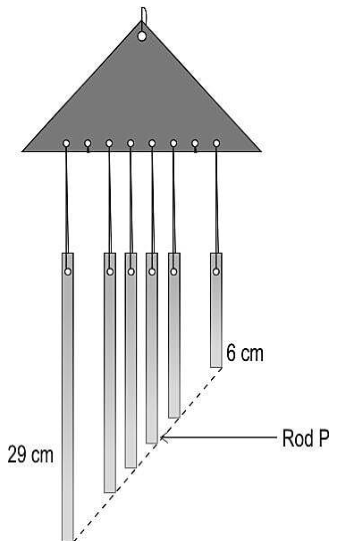
Harsha made a wind chime using a frame and metal rods. She punched 8 holes in the frame, each 2 cm apart, and then hung 6 metal rods from the frame. The ends of the metal rods are aligned over a line shown by the dotted line. If all of the rods are straight and not swaying, then what is the length of Rod P?

Wind chime: triangular frame with 8 holes and 6 hanging rods whose ends lie on a dotted line; longest rod 29 cm, shortest 6 cm; Rod P marked
  1. (A) 69/7 cm
  2. (B) 53/5 cm
  3. (C) 76/5 cm
  4. (D) 111/7 cm
Step-marked solution
  1. [1 mark] The 8 holes are 2 cm apart, so the first and last holes are 7 × 2 = 14 cm apart: the 29 cm rod hangs from the first hole, the 6 cm rod from the last, and Rod P from the 5th hole, 4 × 2 = 8 cm from the first. The rods hang from the straight frame edge and their ends lie on the straight dotted line, so by similar triangles (BPT) the length falls evenly across the frame: Rod P = 29 − (29 − 6) × 8/14 = 29 − 92/7 = 111/7 cm. Answer: (d) 111/7 cm.
5 marksSection D

State and prove Basic proportionality theorem. In ΔABC, if DE ∥ BC, AD = x, DB = x − 2, AE = x + 2 and EC = x − 1, then using the above result, find the value of x.

Step-marked solution
  1. [1 mark] Statement: If a line is drawn parallel to one side of a triangle to intersect the other two sides in distinct points, then the other two sides are divided in the same ratio.
  2. [1 mark] Given and construction: In ΔABC, DE ∥ BC meets AB at D and AC at E. Join BE and CD; draw EM ⊥ AB and DN ⊥ AC.
  3. [1 mark] Proof (areas): ar(ΔADE)/ar(ΔBDE) = AD/DB (triangles on bases AD and DB with the same height EM); similarly ar(ΔADE)/ar(ΔCDE) = AE/EC.
  4. [1 mark] Since ΔBDE and ΔCDE are on the same base DE and between the same parallels DE and BC, ar(ΔBDE) = ar(ΔCDE). Therefore AD/DB = AE/EC.
  5. [1 mark] Application: x/(x − 2) = (x + 2)/(x − 1) ⟹ x(x − 1) = (x + 2)(x − 2) ⟹ x² − x = x² − 4 ⟹ x = 4.
5 marksSection D

In △ABC, D and E lie on sides AB and AC respectively such that DE ∥ BC. It is given that AD = (x + 1) cm, DB = (x − 1) cm, AE = (x + 3) cm and EC = x cm. Find the value of x, and hence write the lengths of AD and AE.

Step-marked solution
  1. [1 mark] Since DE ∥ BC, by the Basic Proportionality Theorem AD/DB = AE/EC.
  2. [1 mark] Substitute: (x + 1)/(x − 1) = (x + 3)/x.
  3. [1 mark] Cross-multiply: x(x + 1) = (x − 1)(x + 3) ⇒ x² + x = x² + 2x − 3.
  4. [1 mark] The x² terms cancel: x = 2x − 3 ⇒ x = 3.
  5. [1 mark] Hence AD = x + 1 = 4 cm and AE = x + 3 = 6 cm (with DB = 2 cm, EC = 3 cm; ratios 4/2 = 6/3 ✓).
Practise Triangles competency questions

Read NCERT Chapter 6 on LazyTopper (jemh106)

Official NCERT chapter PDF (jemh106) — ncert.nic.in

Sources: NCERT 2026-27 (tap to view)
Source ledger PROVENANCE

Source edition: NCERT Reprint 2026-27, Class 10 Mathematics, Ch 6 (jemh106.pdf, printed pages 73-98). One row per sourced item — every verbatim, example and NCERT figure traces to its page.

ItemTypeSource
Similar figuresverbatimNCERT 2026-27 Ch6 (Summary 1)
Similar polygonsverbatimNCERT 2026-27 Ch6
Similar trianglesverbatimNCERT 2026-27 Ch6
Basic Proportionality Theorem (Theorem 6.1)verbatimNCERT 2026-27 Ch6
AAA similarity criterion (Theorem 6.3)verbatimNCERT 2026-27 Ch6
SAS similarity criterion (Theorem 6.5)verbatimNCERT 2026-27 Ch6
Scale factorverbatimNCERT 2026-27 Ch6
Converse of BPT (Theorem 6.2)verbatimNCERT 2026-27 Ch6
SSS similarity criterion (Theorem 6.4)verbatimNCERT 2026-27 Ch6 (Summary 8)
AA similarity criterionverbatimNCERT 2026-27 Ch6
Apply BPT - NCERT Example 1exampleNCERT 2026-27 Ch6 Example 1
Converse of BPT → isosceles - NCERT Example 3exampleNCERT 2026-27 Ch6 Example 3 -84
AAA similarity via parallels - NCERT Example 4exampleNCERT 2026-27 Ch6 Example 4
Real-world AA application (shadow) - NCERT Example 7exampleNCERT 2026-27 Ch6 Example 7 -93
Similar triangles figurefigureNCERT 2026-27 Ch6 Fig. 6.22

Triangles · spec-rendered note · NCERT Reprint 2026-27, Class 10 Mathematics, Ch 6 (jemh106.pdf, printed pages 73-98)

Practise writing answers the way examiners mark them → Guide