Circles Topic Hub

Circles — Class 10 Notes

CBSE 2027 — dates, rules and official papers →
Maths · Ch 10Class 10 · CBSE 2026–27Medium weightage

Circles

What the board actually asks: the two tangent theorems — the tangent is perpendicular to the radius at the point of contact (Theorem 10.1) and the two tangents from an external point are equal (Theorem 10.2) — plus “find the length of the tangent / radius” numericals and circumscribed-figure proofs. Almost every mark here rides on those two theorems.

NCERT VERBATIM sourced, word-for-wordAUTHORED LazyTopper teaching scaffolding
The Big Idea AUTHORED

One point of contact, one right angle.

A tangent touches a circle at exactly one point; a secant cuts it at two. The whole chapter hangs on two facts: at the point of contact the tangent is perpendicular to the radius (Theorem 10.1), and from a point outside the circle you can draw exactly two tangents whose lengths are equal (Theorem 10.2). Together they turn tangent questions into right-triangle and congruence problems you already know how to solve.

Formulae
Tangent ⊥ radius
at the point of contact
Tip: Join the centre to the point of contact first.
Length of a tangent
( = distance of point from centre, = radius)
Tip: ℓ² = d² − r² (right angle at the point of contact).
Equal tangents
(from external point )
Tip: PQ = PR makes △PQR isosceles.
Number of tangents
inside · on · outside
Tip: Inside 0, on 1, outside 2.
Circumscribed quadrilateral
Tip: AB + CD = AD + BC.
Secant, Tangent, Non-intersecting Line
A line that cuts a circle at 2 points is a secant. A line that touches it at exactly 1 point is a tangent. A line that does not meet it (0 points) is non-intersecting.
Angle Between Two Tangents
The angle between the two tangents drawn from an external point is supplementary to the angle subtended at the centre by the line joining the points of contact: .
Parallelogram Circumscribing a Circle
A parallelogram that circumscribes a circle is a rhombus.
Definitions the board rewards NCERT VERBATIM

State these in NCERT’s exact words

Tangent to a circle
NCERT verbatim — memorise this exact wording· Ch 10,
“a tangent to a circle is a line that intersects the circle at only one point.”
What it means: A line that grazes the circle at a single point of contact. Contrast a secant (2 common points) and a non-intersecting line (0). The word comes from the Latin tangere, “to touch”.
Secant of a circle
NCERT verbatim — memorise this exact wording· Ch 10,
“there are two common points A and B that the line PQ and the circle have. In this case, we call the line PQ a secant of the circle.”
What it means: A line that cuts the circle at two points. Slide a secant until its two crossing points merge into one and it becomes a tangent — that limiting idea is the bridge to the whole chapter.
Theorem 10.1 — tangent ⊥ radius
NCERT verbatim — memorise this exact wording· Ch 10,
“The tangent at any point of a circle is perpendicular to the radius through the point of contact.”
What it means: At the point of contact, radius ⊥ tangent — a guaranteed . This right angle is the workhorse of almost every numerical and proof in the chapter (it hands you a right triangle for Pythagoras).
Theorem 10.2 — equal tangents from an external point
NCERT verbatim — memorise this exact wording· Ch 10,
“The lengths of tangents drawn from an external point to a circle are equal.”
What it means: From a point outside, the two tangent segments are equal (). This is what powers the circumscribed-quadrilateral and inscribed-circle proofs; the centre also lies on the bisector of the angle between the two tangents.
Length of the tangent
NCERT verbatim — memorise this exact wording· Ch 10,
“The length of the segment of the tangent from the external point P and the point of contact with the circle is called the length of the tangent from the point P to the circle.”
What it means: The distance from the external point to where the tangent touches the circle. With radius ⊥ tangent it is the leg of a right triangle, so (d = distance of the point from the centre, r = radius).
Key terms — NCERT verbatim (state word-for-word)
Non-intersecting line
In Fig. 10.1 (i), the line PQ and the circle have no common point. In this case, PQ is called a non-intersecting line with respect to the circle. (Ch 10, )
Point of contact
The common point of the tangent and the circle is called the point of contact (Ch 10, )
Tangent = limiting secant
The tangent to a circle is a special case of the secant, when the two end points of its corresponding chord coincide. (Ch 10, )
Must-know concepts AUTHORED FRAMING

…and where they’re tested

A line and a circle — three positions
Given a circle and a line, exactly three things can happen: the line misses the circle (non-intersecting, 0 common points), cuts it at two points (secant), or touches it at one point (tangent). A tangent is the limiting case of a secant whose two crossing points have merged.
NCERT Fig. 10.1A line and a circle: (i) non-intersecting (0 points) · (ii) secant (cuts at A, B) · (iii) tangent (touches at A).
Left to right the line PQ moves from missing the circle, to cutting it twice, to just touching it at one point — the tangent.
1-mark fill-in-the-blank / MCQ (Exercise 10.1 Q2)
Tangent ⊥ radius (Theorem 10.1)
At the point of contact, the tangent is perpendicular to the radius. Proof idea: any other point Q of the tangent lies outside the circle, so ; the radius to the point of contact is therefore the shortest distance from the centre to the tangent, hence perpendicular to it (full proof in the Proof tab). Two consequences NCERT flags in the Remarks: there is one and only one tangent at a point of a circle, and the line along that radius is called the normal at the point.
NCERT Fig. 10.5Theorem 10.1 set-up: tangent XY touches the circle at P and OP is the radius through the point of contact. Any other point Q of XY lies outside the circle, so OQ > OP.
Solid OP is the radius to the point of contact; dotted OQ joins O to another point Q of the tangent. OP is the shortest segment from O to XY, so OP ⟂ XY — the 90° at P is the theorem's conclusion, not a given (NCERT's figure carries no right-angle mark).
the proof itself (the syllabus marks Theorem 10.1 “(Prove)”) and, cited by name, inside almost every circle proof — the carries the mark
How many tangents from a point? 0, 1 or 2
From a point inside the circle you can draw no tangent; from a point on the circle exactly one; from a point outside exactly two. State which case you are in before you start computing.
NCERT Fig. 10.6Number of tangents from a point: (i) inside → no tangent · (ii) on the circle → one · (iii) outside → exactly two (PT₁, PT₂).
Every line through an interior point is a secant (0 tangents); a point on the circle gives 1; an outside point P gives 2 tangents touching at T₁ and T₂.
1-mark conceptual; sets up the length-of-tangent numericals
Equal tangents from an external point (Theorem 10.2)
The two tangents from an outside point have equal length (), so they form an isosceles triangle and the centre lies on the bisector of the angle between them. Labelling equal tangent segments from each vertex is the key move in circumscribed-figure proofs.
NCERT Fig. 10.7Theorem 10.2 set-up: tangents PQ, PR from external point P with radii OQ, OR and OP joined — the two right triangles OQP, ORP are congruent (RHS), so PQ = PR.
Solid PQ, PR are the tangents; dashed OQ, OR, OP are joined for the proof. RHS congruence of △OQP and △ORP gives PQ = PR.
circumscribed quadrilateral/triangle proofs, e.g. — Sections C/D
Length of a tangent — the right-triangle numerical
Because radius ⊥ tangent, the radius, the tangent segment and the line from the point to the centre form a right triangle. Pythagoras gives the length of the tangent , where is the distance of the point from the centre and the radius.
2–3 mark “find the tangent length / find the radius” (Exercise 10.2 Q1, Q6)
Worked examples — real solved problems NCERT VERBATIM

Solved exactly as the source does them

Every problem is a real sourced item, quoted verbatim with its page; the step-by-step decoding and mark-logic are LazyTopper-authored coaching.

Ch 10,
“A tangent PQ at a point P of a circle of radius 5 cm meets a line through the centre O at a point Q so that OQ = 12 cm. Length PQ is :”
Set up the right triangle.The radius is perpendicular to the tangent at (Theorem 10.1), so is right-angled at with hypotenuse .Concept: radius ⊥ tangent
½ mark
Apply Pythagoras. — option (D).Concept: Pythagoras on radius–tangent right triangle
½ mark
Mark-scheme logic (authored): 1-mark MCQ (Section A): radius ⊥ tangent makes right-angled at , then cm, option (D). The trap is choosing (B) 13 by adding the squares instead of subtracting.
Ch 10, Example 1,
“Prove that in two concentric circles, the chord of the larger circle, which touches the smaller circle, is bisected at the point of contact.”
Ch 10, Example 2,
“Two tangents TP and TQ are drawn to a circle with centre O from an external point T. Prove that ∠PTQ = 2∠OPQ.”
Ch 10, Example 3,
“PQ is a chord of length 8 cm of a circle of radius 5 cm. The tangents at P and Q intersect at a point T (see Fig. 10.10). Find the length TP.”
Problem-solving strategies AUTHORED
Tangent + radius in the figure?Mark the point of contact and draw the radius to it — it is ⊥ to the tangent (Theorem 10.1). That unlocks Pythagoras or a right triangle.
Two tangents from one outside point?They are equal (Theorem 10.2). Equal tangents ⇒ an isosceles triangle, and the centre sits on the bisector of the angle between them.
Find a tangent length, radius or distance?Build the radius–tangent–(line-to-centre) right triangle, then apply Pythagoras: .
Circle inscribed in a quadrilateral or triangle?Label the equal tangent segments from each vertex; the opposite-side sums come out equal, e.g. .
How many tangents?Inside → 0, on the circle → 1, outside → 2. State the case before you compute.
Common mistakes that cost marks

Where students lose easy marks

Dropping the perpendicular to the wrong point — the tangent is ⊥ to the radius only at the point of contact, not at any other point of the circle.
Adding instead of subtracting in the tangent right triangle: , so , never .
Skipping the theorem citation in a proof — stating “the tangents are equal” without invoking Theorem 10.2 (or “radius ⊥ tangent” without Theorem 10.1) forfeits the reasoning mark.
Forgetting the isosceles step in an angle problem — equal tangents make the triangle isosceles; without that, the base-angle relation and the whole angle-chase collapse.
Formulae
Tangent ⊥ radius
at the point of contact
Tip: Join the centre to the point of contact first.
Length of a tangent
( = distance of point from centre, = radius)
Tip: ℓ² = d² − r² (right angle at the point of contact).
Equal tangents
(from external point )
Tip: PQ = PR makes △PQR isosceles.
Number of tangents
inside · on · outside
Tip: Inside 0, on 1, outside 2.
Circumscribed quadrilateral
Tip: AB + CD = AD + BC.
Secant, Tangent, Non-intersecting Line
A line that cuts a circle at 2 points is a secant. A line that touches it at exactly 1 point is a tangent. A line that does not meet it (0 points) is non-intersecting.
Angle Between Two Tangents
The angle between the two tangents drawn from an external point is supplementary to the angle subtended at the centre by the line joining the points of contact: .
Parallelogram Circumscribing a Circle
A parallelogram that circumscribes a circle is a rhombus.
Shortcuts & Tricks
Tangent length from (d, r): spot 9-40-41, 5-12-13, 3-4-5.
MCQ / check only: don't write this as working
PA = PB ⇒ base angles equal ⇒ use 180° sum.
Safe in written answers
∠OPT = 90° gives the third angle by angle sum.
Safe in written answers
In a circumscribed quadrilateral AB + CD = half the perimeter.
MCQ / check only: don't write this as working
In proofs state the reason in words: the tangent is perpendicular to the radius at the point of contact; radii of the same circle are equal.
Safe in written answers
Memory Tricks
Andar Zero, Circle pe Ek, Bahar Do.
Number of tangents. Andar (inside) 0 · Circle pe (on the circle) 1 · Bahar (outside) 2.
Chhoone wali line (tangent) radius pe lamb (90°).
Theorem 10.1. tangent at contact ⟂ radius.
Bahar wale point se do tangent, jodi barabar.
Theorem 10.2. PQ = PR.
Mindmap
      • Non-intersecting → 0 common points
      • Secant → 2 common points (A, B)
      • Tangent → 1 point (point of contact)
      • Tangent = limiting secant
      • ⊥ at the point of contact
      • One and only one tangent at a point
      • Radius line at contact = ‘normal’
      • Proof: every other point of the tangent is outside → OP shortest → OP ⟂ XY
      • Inside → 0
      • On the circle → 1
      • Outside → 2
      • Length of tangent = √(d² − r²)
      • PQ = PR from external P
      • ⇒ isosceles triangle
      • Centre on the angle bisector
      • Circumscribed quad: AB + CD = AD + BC
      • Cite Theorem 10.1 / 10.2 by name
      • Subtract in √(d² − r²), never add
      • State the case (0 / 1 / 2) first

The two tangent theorems — 10.1 (tangent ⟂ radius) and 10.2 (equal tangents from an external point)

Both theorems carry a “(Prove)” tag in the 2026-27 syllabus, so either proof can be asked. Theorem 10.1 is a shortest-distance argument: every point of the tangent other than the point of contact lies outside the circle, so the radius to the point of contact is the shortest segment from the centre to the line — and the shortest segment is the perpendicular. Theorem 10.2, the chapter’s workhorse, is then proved by RHS congruence of the two right triangles the radii create. NCERT’s Remarks on 10.2 add two facts: the same result follows from the Pythagoras Theorem (), and since , the centre lies on the bisector of the angle between the two tangents.

Theorem 10.1. Given a circle with centre O and a tangent XY touching it at P. To prove: OP ⟂ XY.
NCERT, p.146: “We are given a circle with centre O and a tangent XY to the circle at a point P. We need to prove that OP is perpendicular to XY.”
Take any point Q on XY other than P and join OQ.
Q must lie outside the circle — if Q were inside, XY would meet the circle at two points and be a secant, not a tangent.
So OQ is longer than the radius OP.
Every point outside the circle is farther from O than the radius.
This holds for every point of XY except P, so OP is the shortest of all distances from O to the line XY — hence OP is perpendicular to XY.
The shortest segment from a point to a line is the perpendicular (NCERT cites Theorem A1.7). Remarks: at any point of a circle there is one and only one tangent, and the line along the radius at the point of contact is the ‘normal’.
Theorem 10.2. Set up what is given and what to prove.
A circle with centre O, a point P outside it, and two tangents PQ, PR from P. Required: PQ = PR.
Join OP, OQ and OR.
OQ and OR are radii to the points of contact Q and R.
The radius–tangent angles are right angles.
Each is the angle between a radius and the tangent at its point of contact, so by Theorem 10.1 they are right angles.
Compare right triangles OQP and ORP.
OQ = OR (radii of the same circle) and OP = OP (common hypotenuse).
The triangles are congruent.
Right angle, hypotenuse and one side equal — RHS congruence.
Hence the tangent lengths are equal.
PQ and PR are corresponding parts of the congruent triangles (CPCT).

3 competency questions from the CBSE board pattern, with the full step-marked solution for each — the marks are shown per step, as the official scheme awards them.

5 marksSection D

In an amusement park, a triangular path ABC circumscribing a circular pond centred at O with radius 8 m is to be constructed, as shown in the figure. The tangent lengths from B are 12 m and from C are 16 m. Find the cost of fencing the triangular path at the rate of Rs 55 per metre.
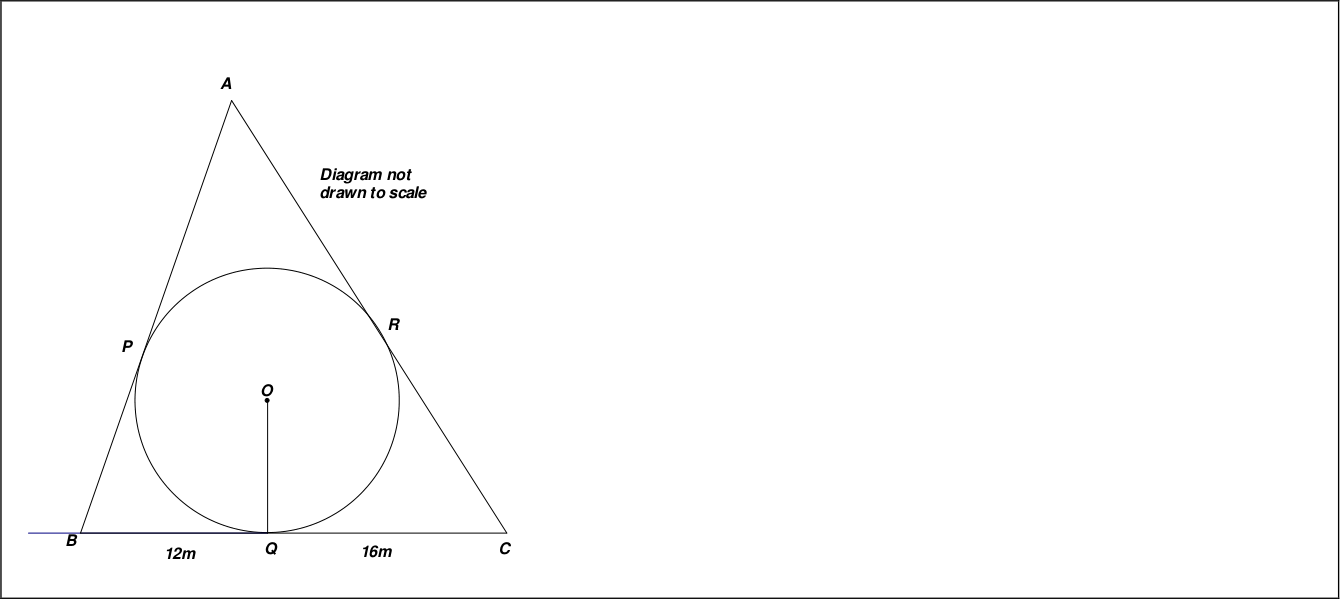
Figure from the question paper for: In an amusement park, a triangular path ABC circumscribing a circular pond centred at O wi
Step-marked solution
  1. [1 mark] Apply the circle theorems: tangent lengths from an external point are equal, so PB = QB = 12 m, RC = QC = 16 m and AP = AR = x (say); also the radius (8 m) is perpendicular to each tangent at the point of contact.
  2. [1 mark] Find ar(△ABC) as the sum of areas of △AOB, △BOC and △AOC: ar(△ABC) = ½ × 8 × (perimeter) = ½ × 8 × 2(28 + x) = 8(28 + x) sq m. … (1)
  3. [1 mark] Using Heron's formula with semi-perimeter s = (28 + x): ar(△ABC) = √[s(s−a)(s−b)(s−c)] = √[(28 + x) · x · 12 · 16] = 4√[(28 + x) · x · 12] sq m. … (2)
  4. [1 mark] Equate (1) and (2): 8(28 + x) = 4√[(28 + x) · x · 12]; squaring gives 4(28 + x)² = 12x(28 + x) → (28 + x)(28 + x − 3x) = 0 → x = 14 (reject x = −28). So perimeter = 2(28 + x) = 84 m.
  5. [1 mark] Cost of fencing = Rs 55 × 84 = Rs 4620.
5 marksSection D

From an external point P, two tangents PA and PB are drawn to a circle with centre O. At a point E on the circle, the tangent intersects PA at C and PB at D. If PA = 10 cm, find the perimeter of triangle PCD.

Step-marked solution
  1. [1 mark] Tangents drawn from an external point are equal, so PA = PB = 10 cm.
  2. [1 mark] From C the two tangents give CA = CE; from D they give DB = DE (equal tangents from an external point).
  3. [1 mark] Perimeter(△PCD) = PC + CD + DP = PC + (CE + ED) + DP.
  4. [1 mark] Substitute CE = CA and ED = DB: = (PC + CA) + (DP + DB) = PA + PB.
  5. [1 mark] Perimeter = 10 + 10 = 20 cm. Hence the perimeter of △PCD is 20 cm.
1 markSection ACBSE 2024

If two tangents inclined at an angle of 60º are drawn to a circle of radius 5 cm, then the length of each tangent is :

  1. (A) 5√3/2 cm
  2. (B) 10 cm
  3. (C) 5/√3 cm
  4. (D) 5√3 cm
Step-marked solution
  1. [1 mark] OP bisects the 60° angle, so ∠APO = 30° with OA ⊥ AP; tan 30° = OA/AP ⟹ 1/√3 = 5/AP ⟹ AP = 5√3 cm → option (d).
Practise Circles competency questions

Read NCERT Chapter 10 on LazyTopper (jemh110)

Official NCERT chapter PDF (jemh110) — ncert.nic.in

Sources: NCERT 2026-27 (tap to view)
Source ledger PROVENANCE

Source edition: NCERT Reprint 2026-27, Class 10 Mathematics, Ch 10 (jemh110.pdf, printed pages 144–153). One row per sourced item — every verbatim, example and NCERT figure traces to its page.

ItemTypeSource
Tangent to a circleverbatimNCERT 2026-27 Ch10
Secant of a circleverbatimNCERT 2026-27 Ch10
Theorem 10.1 — tangent ⊥ radiusverbatimNCERT 2026-27 Ch10
Theorem 10.2 — equal tangents from an external pointverbatimNCERT 2026-27 Ch10
Length of the tangentverbatimNCERT 2026-27 Ch10
Non-intersecting lineverbatimNCERT 2026-27 Ch10
Point of contactverbatimNCERT 2026-27 Ch10
Tangent = limiting secantverbatimNCERT 2026-27 Ch10
Length of a tangent · NCERT Exercise 10.1 Q3exampleNCERT 2026-27 Ch10 Exercise 10.1 Q3
Proof · NCERT Example 1 (concentric circles, chord bisected)exampleNCERT 2026-27 Ch10 Example 1
Proof · NCERT Example 2 (angle between tangents)exampleNCERT 2026-27 Ch10 Example 2
Numerical · NCERT Example 3 (find the tangent length TP)exampleNCERT 2026-27 Ch10 Example 3
NCERT Fig. 10.1 — line and circle: three positionsfigureNCERT 2026-27 Ch10 Fig. 10.1
NCERT Fig. 10.6 — number of tangents from a pointfigureNCERT 2026-27 Ch10 Fig. 10.6
NCERT Fig. 10.7 — Theorem 10.2 set-upfigureNCERT 2026-27 Ch10 Fig. 10.7
NCERT Fig. 10.5 — Theorem 10.1 set-upfigureNCERT 2026-27 Ch10 Fig. 10.5

Circles · spec-rendered note · NCERT Reprint 2026-27, Class 10 Mathematics, Ch 10 (jemh110.pdf, printed pages 144–153)

Practise writing answers the way examiners mark them → Guide