Trigonometry Topic Hub

Trigonometry — Class 10 Notes

CBSE 2027 — dates, rules and official papers →
Maths · Ch 8Class 10 · CBSE 2026–27High weightage

Trigonometry: ratios, identities and heights & distances

What the board actually asks: finding all six ratios from one, evaluating expressions at the specific angles (0/30/45/60/90), proving trigonometric identities, and one heights-and-distances word problem (angle of elevation / depression — only 30°, 45°, 60°, at most two right triangles). The identity manipulations, the specific-angle table and the heights-and-distances figure carry almost every mark here.

NCERT VERBATIM sourced, word-for-wordAUTHORED LazyTopper teaching scaffolding
The Big Idea AUTHORED

Sides become numbers.

Fix an acute angle in a right triangle and the ratios of its sides stop depending on how big the triangle is - they depend only on the angle. Those six fixed numbers are the trigonometric ratios (sin, cos, tan and their reciprocals cosec, sec, cot). This chapter does three things: defines the ratios, pins down their exact values at , and proves the identity (with its two cousins) that turns messy expressions into . The applications chapter (Ch 9) then turns a real scene - a tower, a kite, a ship seen from a lighthouse - into a right triangle whose angle of elevation or depression you know, so one trigonometric ratio gives the height or distance you cannot measure.

Formulae

Trigonometric Ratios: sin, cos, tan

Six ratios
Tip: Mark opposite / adjacent from the angle asked, not from the picture.
Reciprocals
Tip: Flip the ratio.

Trigonometry Table (0° to 90°)

Values of the six ratios

Trigonometric Identities (sin²A + cos²A = 1 and two more)

Identities
Tip: Convert everything to sin and cos and work on one side only (usually the harder side), writing every line.
Heights & distances
· elevation: look up · depression: look down (= elevation from the other end)
Tip: The angle of depression from the top equals the angle of elevation from the bottom.
tan A = sin A / cos A, cot A = cos A / sin A
and .
Identities in Other Forms
· · ·
Range of sin and cos
For an acute angle, and are less than 1, because the hypotenuse is the longest side of a right triangle.
Line of Sight, Angle of Elevation and Depression
The line of sight is the line from the eye to the object. The angle of elevation is measured upward from the horizontal; the angle of depression is measured downward from the horizontal. Use when the height and the ground distance are involved; use or when a rope or ladder (the hypotenuse) is involved. Problems use angles of 30°, 45° and 60° only, with at most two right triangles.
Definitions the board rewards NCERT VERBATIM

State these in NCERT’s exact words

Trigonometry
NCERT verbatim — memorise this exact wording· Ch 8,
“Trigonometry is the study of relationships between the sides and angles of a triangle.”
What it means: the word comes from the Greek (three), (sides), (measure). In Class 10 we study it for the acute angles of a right triangle only.
Opposite, adjacent, hypotenuse
NCERT verbatim — memorise this exact wording· Ch 8,
“We call it the side opposite to angle A. AC is the hypotenuse of the right triangle and the side AB is a part of ∠A. So, we call it the side adjacent to angle A.”
What it means: name the three sides relative to the angle you are working with: the side facing the angle is opposite, the longest side (facing the right angle) is the hypotenuse, the third is adjacent. Switch to angle C and opposite/adjacent swap.
Trigonometric ratios
NCERT verbatim — memorise this exact wording· Ch 8,
“So, the trigonometric ratios of an acute angle in a right triangle express the relationship between the angle and the length of its sides.”
What it means: , , . Memorise them against the labelled triangle, not as isolated letters.
Ratios independent of side length
NCERT verbatim — memorise this exact wording· Ch 8,
“The values of the trigonometric ratios of an angle do not vary with the lengths of the sides of the triangle, if the angle remains the same.”
What it means: this is why the ratios are well defined - proved by AA similarity. It lets you set the sides as (any positive ): the ratio cancels , so the answer never depends on your choice.
Trigonometric identity
NCERT verbatim — memorise this exact wording· Ch 8,
“An equation involving trigonometric ratios of an angle is called a trigonometric identity, if it is true for all values of the angle(s) involved.”
What it means: an identity holds for every valid angle, so you prove it by algebra, not by plugging in one value. To prove one, transform the LHS until it becomes the RHS.
Angle of elevation
NCERT verbatim — memorise this exact wording· Ch 9,
“The angle of elevation of an object viewed, is the angle formed by the line of sight with the horizontal when it is above the horizontal level, i.e., the case when we raise our head to look at the object.”
What it means: you look up at the object: the angle between the horizontal through your eye and the line of sight. It sits at the observer, never at the top of the tower.
Angle of depression
NCERT verbatim — memorise this exact wording· Ch 9,
“The angle of depression of an object viewed, is the angle formed by the line of sight with the horizontal when it is below the horizontal level, i.e., the case when we lower our head to look at the object.”
What it means: you look down at the object: the angle between the horizontal through your eye and the line of sight. By alternate angles it equals the angle of elevation of your eye from that object - which is how it enters the right triangle on the ground.
Key terms — NCERT verbatim (state word-for-word)
Reciprocal ratios
The ratios defined above are abbreviated as sin A, cos A, tan A, cosec A, sec A and cot A respectively. Note that the ratios cosec A, sec A and cot A are respectively, the reciprocals of the ratios sin A, cos A and tan A. (Ch 8, )
sin A, cos A never exceed 1
Since the hypotenuse is the longest side in a right triangle, the value of sin A or cos A is always less than 1 (or, in particular, equal to 1). (Ch 8, )
sin A is not sin times A
sin A is not the product of ‘sin’ and A. ‘sin’ separated from A has no meaning. (Ch 8, )
Line of sight
Thus, the line of sight is the line drawn from the eye of an observer to the point in the object viewed by the observer. (Ch 9, )
Must-know concepts AUTHORED FRAMING

…and where they’re tested

Find every ratio from one
Given one ratio, draw a right triangle and mark the two sides in that ratio as multiples of (e.g. opposite , adjacent ). Get the third side by Pythagoras, then read all six ratios straight off - always cancels.
NCERT Fig. 8.4Right triangle ABC (right-angled at B): AC is the hypotenuse, BC the side opposite to angle A, AB the side adjacent to angle A - the labels the six ratios are built on.
Relative to angle A at the bottom-left: the side across from it (BC) is 'opposite', the longest side (AC, across from the right angle) is the 'hypotenuse', the remaining side (AB) is 'adjacent'.
2-3 mark “find the other trigonometric ratios”
Ratios of the specific angles
The exact values at come from the -- and -- triangles (Table 8.1). rises , falls ; , , , are not defined. Learn the table cold - it is assumed in every evaluation question.
“Evaluate” expressions in specific angles (Exercise 8.2)
The three Pythagorean identities
; (for ); (for ). All three come from Pythagoras. Mind the angle ranges - break at , break at .
MCQ simplifications like (Exercise 8.3 Q3)
Proving identities (LHS → RHS)
Convert everything to and , take a common denominator, and use (often via ). Work on one side only until it becomes the other - never manipulate both sides at once.
3-5 mark “prove that …” (Exercise 8.3 Q4)
Heights and distances - angle of elevation
Turn the scene into a right triangle: the vertical height, the horizontal distance and the line of sight. Mark the angle of elevation at the observer's eye when the object is above the horizontal. Then pick the one ratio that links the known side and the wanted side - usually , or when the hypotenuse (a ladder, a string, a rope) is involved - and read its value from Table 8.1.
NCERT Fig. 9.2Fig 9.2 — Angle of elevation: the object is above the horizontal level, so the line of sight rises from the eye. The angle is measured at the observer's eye, between the horizontal level and the line of sight.
The dashed line is the horizontal level through the eye; the solid line is the line of sight up to the object; the arc between them is the angle of elevation. Elevation: head raised.
2-mark one-triangle problem (Exercise 9.1 Q1, Q4) · 3-mark two-triangle problem (Exercise 9.1 Q7)
Heights and distances - angle of depression
Mark the angle of depression at the observer's eye when the object is below the horizontal (alternate angles carry it down to the far end of the triangle). Board problems use only , and , and at most two right triangles (a flagstaff on a building, two ships from a lighthouse, a shadow at two altitudes); add the observer's height at the end if the eye is above the ground.
NCERT Fig. 9.3Fig 9.3 — Angle of depression: the object is below the horizontal level, so the line of sight falls from the eye. The angle is measured at the observer's eye, between the horizontal level and the line of sight.
The dashed line is the horizontal level through the girl's eye on the balcony; the solid line is the line of sight down to the object; the angle between them is the angle of depression. Depression: head lowered.
3-mark two-triangle problem (Exercise 9.1 Q13)
Worked examples — real solved problems NCERT VERBATIM

Solved exactly as the source does them

Every problem is a real sourced item, quoted verbatim with its page; the step-by-step decoding and mark-logic are LazyTopper-authored coaching.

Ch 8, Example 1,
“Given tan A = 4/3, find the other trigonometric ratios of the angle A.”
Set up from tan A., so take and for a positive number .Concept: assign sides in the given ratio
½ mark
Third side by Pythagoras., so .Concept: Pythagoras for the missing side
½ mark
Read off sin and cos. and .Concept: opposite/hypotenuse, adjacent/hypotenuse
1 mark
Reciprocals give the rest., and .Concept: cosec/sec/cot are reciprocals
1 mark
Mark-scheme logic (authored): 3-mark shape: correct side ratio + Pythagoras (1) · and (1) · the three reciprocal ratios (1). Setting the sides as keeps the answer independent of - the whole point of the ratios.
Ch 8, Example 3,
“Consider △ACB, right-angled at C, in which AB = 29 units, BC = 21 units and ∠ABC = θ (see Fig. 8.10). Determine the values of (i) cos²θ + sin²θ, (ii) cos²θ – sin²θ”
Ch 8, Example 6,
“In △ABC, right-angled at B, AB = 5 cm and ∠ACB = 30° (see Fig. 8.19). Determine the lengths of the sides BC and AC.”
Ch 8, Example 10,
“Prove that sec A (1 – sin A)(sec A + tan A) = 1.”
Ch 9, Example 1,
“A tower stands vertically on the ground. From a point on the ground, which is 15 m away from the foot of the tower, the angle of elevation of the top of the tower is found to be 60°. Find the height of the tower.”
Ch 9, Example 7,
“From a point on a bridge across a river, the angles of depression of the banks on opposite sides of the river are 30° and 45°, respectively. If the bridge is at a height of 3 m from the banks, find the width of the river.”
Problem-solving strategies AUTHORED
Given one ratio, want the others?Draw the triangle, set the two sides as -multiples, get the third by Pythagoras, read off all six.
“Evaluate …” at specific angles?Substitute straight from Table 8.1. Do not re-derive - recall at instantly.
“Prove that …” (identity)?Turn everything into and , take a common denominator, apply . Work one side only.
A ratio looks like it could be ?Check: and are at most ; and are at least . If not, re-check opposite vs adjacent.
Angle changes from A to C?Opposite and adjacent swap. Re-label before writing the ratio - this is the most common slip.
Heights & distances word problem?Draw the right triangle first, mark the right angle and the angle of elevation / depression at the eye, then write the ONE ratio linking the known and wanted sides (usually ). Only , , appear - recall them from Table 8.1.
Common mistakes that cost marks

Where students lose easy marks

Swapping opposite and adjacent when the angle changes (angle A vs angle C) - re-label the sides against the new angle first.
Claiming or - impossible, since the hypotenuse is the longest side.
Reading as - ‘sin’ with no angle is meaningless.
Writing or for undefined ratios - , , , are ‘not defined’.
Ignoring the identity's angle range - holds for , not at .
Marking the angle of depression at the foot of the object - it is measured at the observer's eye, below the horizontal; it reaches the ground triangle only as the equal alternate angle.
Formulae

Trigonometric Ratios: sin, cos, tan

Six ratios
Tip: Mark opposite / adjacent from the angle asked, not from the picture.
Reciprocals
Tip: Flip the ratio.

Trigonometry Table (0° to 90°)

Values of the six ratios

Trigonometric Identities (sin²A + cos²A = 1 and two more)

Identities
Tip: Convert everything to sin and cos and work on one side only (usually the harder side), writing every line.
Heights & distances
· elevation: look up · depression: look down (= elevation from the other end)
Tip: The angle of depression from the top equals the angle of elevation from the bottom.
tan A = sin A / cos A, cot A = cos A / sin A
and .
Identities in Other Forms
· · ·
Range of sin and cos
For an acute angle, and are less than 1, because the hypotenuse is the longest side of a right triangle.
Line of Sight, Angle of Elevation and Depression
The line of sight is the line from the eye to the object. The angle of elevation is measured upward from the horizontal; the angle of depression is measured downward from the horizontal. Use when the height and the ground distance are involved; use or when a rope or ladder (the hypotenuse) is involved. Problems use angles of 30°, 45° and 60° only, with at most two right triangles.
Shortcuts & Tricks
Spot 3-4-5, 5-12-13, 8-15-17, 7-24-25 triangles to get the third side.
MCQ / check only: don't write this as working
Shadow = √3 × height ⇒ 30°; shadow = height ⇒ 45°; height = √3 × shadow ⇒ 60°.
MCQ / check only: don't write this as working
For an acute angle θ: sin θ = cos θ ⇒ θ = 45° and tan θ = 1.
MCQ / check only: don't write this as working
Prove identities by converting to sin and cos and simplifying ONE side, writing every line.
Safe in written answers
Draw, mark the given angle, name the right triangle(s), choose tan for height÷ground.
Safe in written answers
Memory Tricks

SOH CAH TOA: Trigonometric Ratios Trick

Sonu Oye Harsh! · Chandu Aaya Hai! · Tina Office Aayi.
sin = opposite/hypotenuse; cos = adjacent/hypotenuse; tan = opposite/adjacent. S-O-H = sin, opposite, hypotenuse · C-A-H = cos, adjacent, hypotenuse · T-O-A = tan, opposite, adjacent.

Trigonometry Table Trick (sin 0° to 90°)

0, 1, 2, 3, 4 ka root, sab upon 2.
sin 0°, 30°, 45°, 60°, 90°. √0/2 = 0 · √1/2 = 1/2 · √2/2 = 1/√2 · √3/2 · √4/2 = 1.

Trigonometry Table Trick (cos 0° to 90°)

Cosine = sine wali row, ulte kram mein (4, 3, 2, 1, 0 ka root, upon 2).
cos 0° … 90°. √4/2 = 1 · √3/2 · √2/2 · √1/2 · √0/2 = 0.
Har jodi mein ek 'co': sin ↔ COsec, COs ↔ sec, tan ↔ COt.
reciprocals. sin=1/cosec, cos=1/sec, tan=1/cot.
Tan–Sec ki jodi, Cot–Cosec ki jodi; 1 hamesha baayen taraf, Tan²/Cot² ke saath.
1 + tan²A = sec²A; 1 + cot²A = cosec²A. Tan pairs with Sec, Cot with Cosec; the "1" sits on the left with tan²A / cot²A.
Mindmap
      • sin = opp/hyp, cos = adj/hyp, tan = opp/adj
      • cosec, sec, cot = reciprocals
      • Depend on the angle, not the triangle's size
      • sin A, cos A never exceed 1
      • Set sides as k-multiples in the given ratio
      • Third side by Pythagoras
      • Read off every ratio (k cancels)
      • 0, 30, 45, 60, 90
      • From 45-45-90 and 30-60-90 triangles
      • tan 90, cot 0, sec 90, cosec 0 not defined
      • sin²A + cos²A = 1
      • 1 + tan²A = sec²A (0 ≤ A < 90)
      • 1 + cot²A = cosec²A (0 < A ≤ 90)
      • Prove others by LHS → RHS
      • Line of sight; angle of elevation (look up) / depression (look down)
      • Draw the right triangle, mark the right angle
      • tan θ links height and horizontal distance
      • Only 30°, 45°, 60°; at most two right triangles
      • Opposite/adjacent swap when the angle changes
      • Ratio wrongly > 1
      • Undefined ≠ 0 or ∞
      • Ignoring an identity's angle range

The Pythagorean trigonometric identities

NCERT proves one identity, , directly from the Pythagoras theorem, then derives the other two by dividing the same relation differently. Every identity in the chapter ultimately rests on these three (p.128-129).

Start from Pythagoras in △ABC, right-angled at B.
Divide each term of (1) by .
True for all A with , so it is a trigonometric identity.
Divide (1) by instead.
are undefined at , so this holds for .
Divide (1) by .
are undefined at , so this holds for .

3 competency questions from the CBSE board pattern, with the full step-marked solution for each — the marks are shown per step, as the official scheme awards them.

1 markSection A

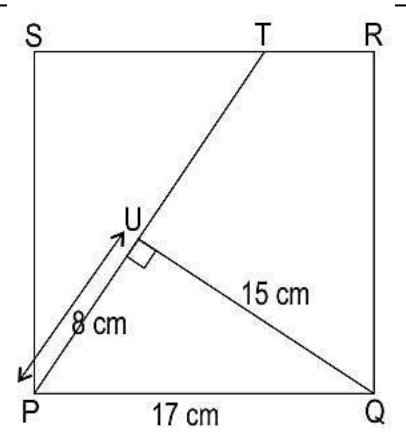
In the figure, PQRS is a square. What is the value of sin ∠SPT?

Figure from the question paper for: In the figure, PQRS is a square. What is the value of sin ∠SPT?
  1. (A) 8/17
  2. (B) 8/15
  3. (C) 15/17
  4. (D) (cannot be found with the given information)
Step-marked solution
  1. [1 mark] From the figure, ∠PUQ = 90°, PU = 8 cm, UQ = 15 cm, PQ = 17 cm. Since ∠SPQ = 90°, ∠SPT + ∠UPQ = 90°; in right △PUQ, ∠PQU + ∠UPQ = 90°. So ∠SPT = ∠PQU, and sin ∠SPT = sin ∠PQU = PU/PQ = 8/17.
5 marksSection D

A man on the top of a vertical tower observes a car moving at a uniform speed coming directly towards it. If it takes 12 minutes for the angle of depression to change from 30° to 45°, how soon after this will the car reach the tower? Give your answer to nearest minutes. (Use √3 = 1.73). OR If the angle of elevation of a cloud from a point 10 metres above a lake is 30° and the angle of depression of its reflection in the lake is 60°, find the height of the cloud from the surface of the lake.

Step-marked solution
  1. [1 mark] Let AB be the tower of height h and let the car move from D (angle of depression 30°) to C (angle of depression 45°) in 12 minutes; let the uniform speed give distance DC covered in 12 minutes.
  2. [1 mark] In ΔABC (depression 45°): tan 45° = AB/BC ⟹ BC = AB.
  3. [1 mark] In ΔABD (depression 30°): tan 30° = AB/BD ⟹ BD = √3·AB.
  4. [1 mark] DC = BD − BC = (√3 − 1)·AB, and this is covered in 12 minutes; time to cover BC = AB at the same speed = 12 × BC/DC = 12/(√3 − 1).
  5. [1 mark] Time = 12/(√3 − 1) = 6(√3 + 1) = 6(2.73) ≈ 16 minutes. [OR variant — cloud over a lake: observer 10 m above lake, horizontal distance x. tan 30° = (h − 10)/x and tan 60° = (h + 10)/x; dividing, 3 = (h + 10)/(h − 10) ⟹ 3h − 30 = h + 10 ⟹ h = 20 m.]
2 marksSection B

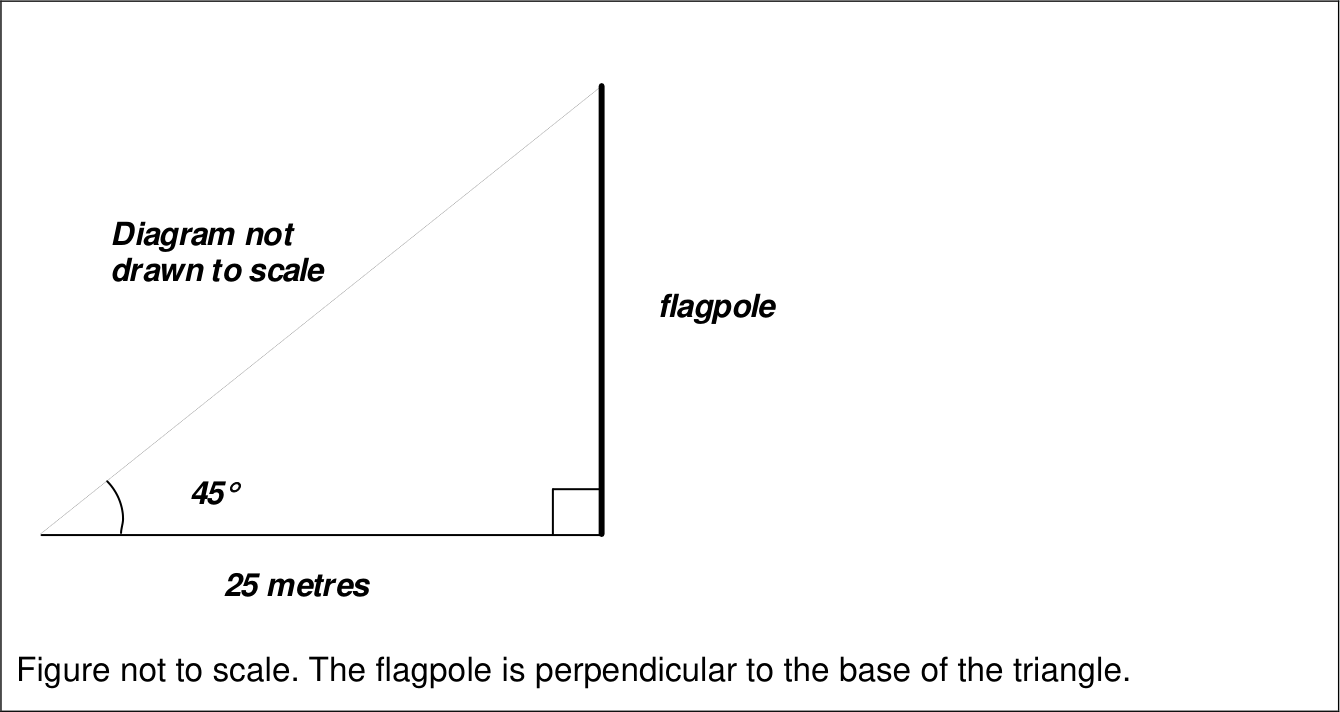
A flagpole casts its shadow that is 25 m long on the ground. The angle made by the tip of the flagpole and the tip of its shadow on the ground is 45°. Find the height of the flagpole.

Figure from the question paper for: A flagpole casts its shadow that is 25 m long on the ground. The angle made by the tip of
Step-marked solution
  1. [1 mark] tan 45° = opposite/adjacent = (height of flagpole)/25.
  2. [1 mark] 1 = (height of flagpole)/25 → height of flagpole = 25 m.
Practise Trigonometry: ratios, identities and heights & distances competency questions

Read NCERT Chapter 8 on LazyTopper (jemh108)Chapter 9

Official NCERT chapter PDF (jemh108) — ncert.nic.in

Sources: NCERT 2026-27 (tap to view)
Source ledger PROVENANCE

Source edition: NCERT Reprint 2026-27, Class 10 Mathematics, Ch 8 (jemh108.pdf, printed pages 113-132) and Ch 9 Some Applications of Trigonometry (jemh109.pdf, printed pages 133-143). One row per sourced item — every verbatim, example and NCERT figure traces to its page.

ItemTypeSource
TrigonometryverbatimNCERT 2026-27 Ch8
Opposite, adjacent, hypotenuseverbatimNCERT 2026-27 Ch8
Trigonometric ratiosverbatimNCERT 2026-27 Ch8
Ratios independent of side lengthverbatimNCERT 2026-27 Ch8
Trigonometric identityverbatimNCERT 2026-27 Ch8
Reciprocal ratiosverbatimNCERT 2026-27 Ch8
sin A, cos A never exceed 1verbatimNCERT 2026-27 Ch8
sin A is not sin times AverbatimNCERT 2026-27 Ch8
Angle of elevationverbatimNCERT 2026-27 Ch9 p.143 (Summary 1(ii))
Angle of depressionverbatimNCERT 2026-27 Ch9 p.143 (Summary 1(iii))
Line of sightverbatimNCERT 2026-27 Ch9 p.133
All ratios from one · NCERT Example 1exampleNCERT 2026-27 Ch8 Example 1
Evaluate cos² + sin² · NCERT Example 3exampleNCERT 2026-27 Ch8 Example 3
Specific angle 30° · NCERT Example 6exampleNCERT 2026-27 Ch8 Example 6
Prove an identity · NCERT Example 10exampleNCERT 2026-27 Ch8 Example 10
Height of a tower (one right triangle) · NCERT Ch 9 Example 1exampleNCERT 2026-27 Ch9 Example 1 p.135
Width of a river from angles of depression (two right triangles) · NCERT Ch 9 Example 7exampleNCERT 2026-27 Ch9 Example 7 p.140-141
fig_ratio_triangle_84figureNCERT 2026-27 Ch8 Fig. 8.4
fig_angle_of_elevation_92figureNCERT 2026-27 Ch9 Fig. 9.2 p.134
fig_angle_of_depression_93figureNCERT 2026-27 Ch9 Fig. 9.3 p.134

Trigonometry: ratios, identities and heights & distances · spec-rendered note · NCERT Reprint 2026-27, Class 10 Mathematics, Ch 8 (jemh108.pdf, printed pages 113-132) and Ch 9 Some Applications of Trigonometry (jemh109.pdf, printed pages 133-143)

Practise writing answers the way examiners mark them → Guide