Our Environment Topic Hub

Our Environment — Class 10 Notes

CBSE 2027 — dates, rules and official papers →
Biology · Ch 13Class 10 · CBSE 2026–27Medium weightage

Our Environment

What the board actually asks: define-and-distinguish the components of an ecosystem (biotic vs abiotic; producers, consumers, decomposers), read food chains and food webs and name their trophic levels, apply the 10% law of energy flow (and explain why food chains have only three or four steps), explain biological magnification, describe the ozone layer and how CFCs deplete it, and separate biodegradable from non-biodegradable waste with their effects - a short but high-yield Unit V chapter examined mostly through 2-3 mark reasoning and one assertion-reason or case item.

NCERT VERBATIM sourced, word-for-wordAUTHORED LazyTopper teaching scaffolding
The Big Idea AUTHORED

Everything is linked - energy flows one way, matter cycles, and what we dump comes back to us.

An ecosystem is living organisms plus their non-living surroundings interacting as one balanced unit. Energy from the Sun enters through green producers and passes up the food chain, but only about a tenth carries over at each step, so food chains stay short. The same chains carry our mistakes upward - non-degradable pesticides concentrate in the top consumer (us), CFCs thin the protective ozone layer, and non-biodegradable waste piles up. Most marks here reward clear reasoning and the exact NCERT terms, not long descriptions.

Formulae
10% law of energy transfer
About 10% of the energy at one trophic level passes to the next; the other ~90% is lost as heat, digestion and work
Energy captured by producers
Green plants capture only about 1% of the sunlight falling on their leaves and store it as food energy
Tip: ~1% of sunlight.
Length of a food chain
Food chains generally have only 3 or 4 trophic levels - little usable energy remains after four levels
Trophic levels (order)
Producers (1st) to Primary consumers / herbivores (2nd) to Secondary consumers (3rd) to Tertiary consumers (4th)
Ozone formation
(free oxygen atoms); then (ozone)
Tip: O₂ → O + O under UV; O + O₂ → O₃.
Components of an Ecosystem
An ecosystem has biotic components (living organisms: producers, consumers and decomposers) and abiotic components (non-living: air, water, soil, sunlight). Forests, ponds and lakes are natural ecosystems; gardens and crop fields are human-made.
Food Chain and Food Web
A food chain is one path along which food and energy pass from one organism to the next. A food web is many food chains linked together.
Biological Magnification
Pesticides and other chemicals used on crops are washed into the soil and water bodies and absorbed by plants. They are not broken down, so they pass up the food chain and accumulate at each trophic level. Human beings are at the top, so the largest amounts collect in our bodies. This is biological magnification.
Ozone Layer Depletion and CFCs
Ozone at higher levels of the atmosphere shields the Earth from the Sun's harmful ultraviolet radiation. Chlorofluorocarbons (CFCs), used as refrigerants and in fire extinguishers, caused a sharp drop in ozone. In 1987 the United Nations Environment Programme (UNEP) got an agreement to freeze CFC production.
Biodegradable and Non-biodegradable Substances
Substances that are broken down by biological processes are biodegradable. Those that are not broken down (such as many plastics) are non-biodegradable; they persist in the environment and harm it.
Types of Consumers
Consumers are herbivores, carnivores, omnivores and parasites.
Role of Decomposers
Bacteria and fungi break down the dead remains and waste of organisms into simple substances that return to the soil.
Definitions the board rewards NCERT VERBATIM

State these in NCERT’s exact words

Ecosystem
NCERT verbatim — memorise this exact wording· Ch 13,
“All the interacting organisms in an area together with the non-living constituents of the environment form an ecosystem. Thus, an ecosystem consists of biotic components comprising living organisms and abiotic components comprising physical factors like temperature, rainfall, wind, soil and minerals.”
What it means: A community of living things (biotic) plus their non-living surroundings (abiotic) interacting as one balanced unit - a garden, forest, pond or aquarium.
Producers
NCERT verbatim — memorise this exact wording· Ch 13,
“All green plants and certain bacteria which can produce food by photosynthesis come under this category and are called the producers.”
What it means: Green plants and some bacteria that make their own food by photosynthesis - the first link that brings energy into every food chain.
Consumers
NCERT verbatim — memorise this exact wording· Ch 13,
“These organisms which consume the food produced, either directly from producers or indirectly by feeding on other consumers are the consumers.”
What it means: Organisms that cannot make their own food and instead eat producers or other consumers - classed as herbivores, carnivores, omnivores and parasites.
Decomposers
NCERT verbatim — memorise this exact wording· Ch 13,
“These microorganisms are the decomposers as they break-down the complex organic substances into simple inorganic substances that go into the soil and are used up once more by the plants.”
What it means: Bacteria and fungi that break down dead remains and wastes into simple substances returned to the soil, so nutrients are recycled to the producers.
Trophic level
NCERT verbatim — memorise this exact wording· Ch 13,
“Each step or level of the food chain forms a trophic level.”
What it means: Each feeding step of a food chain - producers are the first level, primary consumers the second, secondary the third and tertiary the fourth.
Biological magnification
NCERT verbatim — memorise this exact wording· Ch 13,
“As human beings occupy the top level in any food chain, the maximum concentration of these chemicals get accumulated in our bodies. This phenomenon is known as biological magnification.”
What it means: The progressive build-up of non-degradable chemicals (like pesticides) at each higher trophic level, reaching its maximum in the top consumer - us.
Ozone
NCERT verbatim — memorise this exact wording· Ch 13,
“Ozone (O3) is a molecule formed by three atoms of oxygen.”
What it means: A molecule of three oxygen atoms; high in the atmosphere it forms a shield against the Sun's harmful UV radiation, though near the ground it is a deadly poison.
Key terms — NCERT verbatim (state word-for-word)
Food web
So instead of a straight line food chain, the relationship can be shown as a series of branching lines called a food web. (Ch 13, )
Chlorofluorocarbons (CFCs)
This decrease has been linked to synthetic chemicals like chlorofluorocarbons (CFCs) which are used as refrigerants and in fire extinguishers. (Ch 13, )
Biodegradable
Substances that are broken down by biological processes are said to be biodegradable. (Ch 13, )
Non-biodegradable
Substances that are not broken down in this manner are said to be non-biodegradable. (Ch 13, )
Must-know concepts AUTHORED FRAMING

…and where they’re tested

Ecosystem and its components
Every ecosystem has biotic components (all the living organisms) and abiotic components (physical factors like temperature, rainfall, wind, soil and minerals). The living organisms group by how they feed: producers (green plants, some bacteria) make food by photosynthesis, consumers (herbivores, carnivores, omnivores, parasites) eat others, and decomposers (bacteria, fungi) break down the dead into simple substances the plants reuse. Natural ecosystems are forests, ponds and lakes; gardens and crop-fields are human-made.
3-mark: list the biotic and abiotic components of an ecosystem; role of decomposers in the ecosystem.
Food chains, food webs and trophic levels
A food chain is a series of organisms feeding on one another; each feeding step is a trophic level, with producers at the first level, primary consumers (herbivores) at the second, secondary consumers at the third and tertiary consumers at the fourth. In nature an organism is usually eaten by several kinds of organisms, so the many chains interconnect into a branching food web rather than a single straight line.
NCERT Fig 13.1Food chain in nature (a) in forest, (b) in grassland and (c) in a pond
Three food chains, each read bottom-to-top from the producer: (a) forest - tree to deer to tiger; (b) grassland - grass to grasshopper to frog to snake to a bird of prey; (c) pond - aquatic plant to scorpion/insect to fish to heron.
2-3 mark: identify a valid food chain and name its trophic levels; difference between a food chain and a food web.
Flow of energy and the 10% law
Energy flow is one-way: green plants in a terrestrial ecosystem capture only about 1% of the sunlight falling on their leaves and store it as food energy. When that food is eaten, an average of only 10% of the food is built into the consumer's own body and passed on - the rest is lost as heat, digestion and work. Because so little energy reaches the next level, food chains generally have only three or four steps, and the energy never returns to a lower level.
NCERT Fig 13.4Diagram showing flow of energy in an ecosystem
Stacked bars narrowing upward - Sunlight to Producers to Herbivores to Carnivores to Top Carnivores - each bar shorter than the one below it, picturing the loss of energy at every trophic level.
3-mark: state the 10% law and explain why food chains are limited to three or four trophic levels; why energy flow is unidirectional.
Biological magnification
Pesticides and other chemicals sprayed on crops wash into the soil and water and are taken up by plants and aquatic plants, entering the food chain. Because these chemicals are not degradable, they are not broken down or thrown out but accumulate progressively at each higher trophic level. As human beings sit at the top of most food chains, the maximum concentration collects in us - this is biological magnification, and it cannot always be washed off our food.
3-mark: what is biological magnification and why is its level different at different trophic levels.
Ozone layer and its depletion
Ozone (O3) high in the atmosphere shields the Earth from the Sun's ultraviolet (UV) radiation, which causes skin cancer. It forms when high-energy UV splits molecular oxygen (O2) into free atoms that then join O2 to make O3. From the 1980s the ozone amount dropped sharply, linked to synthetic CFCs used as refrigerants and in fire extinguishers; in 1987 UNEP forged an agreement to freeze CFC production at 1986 levels.
2-3 mark: how is ozone formed and why is damage to the ozone layer a cause for concern; which chemicals cause its depletion.
Managing the garbage we produce
Substances broken down by biological processes (the action of bacteria and saprophytes) are biodegradable; those that are not are non-biodegradable. Enzymes are specific, so micro-organisms cannot break down man-made materials like plastics, which persist for a long time and may harm members of the ecosystem. Changes in life-style and packaging have made more of our waste non-biodegradable, so separating and disposing of waste has become a serious environmental problem.
3-mark: distinguish biodegradable and non-biodegradable substances with examples; two ways each type affects the environment.
Worked examples — real solved problems NCERT VERBATIM

Solved exactly as the source does them

Every problem is a real sourced item, quoted verbatim with its page; the step-by-step decoding and mark-logic are LazyTopper-authored coaching.

Example Section 13.1.1 (flow of energy) walkthrough,
“Trace how energy passes along the food chain grass to deer to tiger, and explain why so little reaches the top carnivore. [authored prompt]”
Energy enters at the producers.Grass, a green producer, captures only about 1% of the sunlight that falls on its leaves and stores it as food energy - this is the energy that enters the food chain.
1 mark
First transfer to the herbivore.When the deer (primary consumer) eats the grass, an average of only 10% of the food eaten is turned into its own body; the rest is lost as heat to the environment and used in digestion and work.
1 mark
Second transfer to the carnivore.When the tiger (secondary consumer) eats the deer, again only about 10% carries over, so the energy available drops to roughly a tenth at each successive trophic level.
1 mark
Why chains stay short.Because the loss at each step is so great, very little usable energy remains after four trophic levels, so food chains generally consist of only three or four steps.
Mark-scheme logic (authored): CBSE 3-mark - 1 mark for ~1% capture by producers, 1 mark for the 10% transfer to the primary consumer, and 1 mark for the 10% transfer to the next level. The closing point on why chains are limited to three or four steps completes the reasoning but is not separately credited in the 3-mark scheme.
Example Section 13.1.1 (biological magnification) walkthrough,
“Trace how a non-degradable pesticide sprayed on a crop ends up most concentrated in human beings. [authored prompt]”
Example Section 13.2.1 walkthrough,
“Explain how ozone is formed high in the atmosphere and how human activity has depleted it. [authored prompt]”
Example Section 13.2.2 walkthrough,
“A vegetable peel and a plastic bag are buried in the same pit - explain what happens to each and how they affect the environment. [authored prompt]”
Problem-solving strategies AUTHORED
"Which is a food chain?" MCQ?A valid chain must run producer to consumer to consumer with each eating the one before it - reject options that are all plants or all animals (e.g. grass, wheat, mango is NOT a chain; grass, goat, human IS).
10% numerical asked?Take a tenth at every step: if producers hold 10000 J, herbivores get about 1000 J, small carnivores about 100 J, top carnivores about 10 J - then explain the loss is why chains rarely pass four levels.
"Differences between" asked?Answer in a two-column table (biodegradable vs non-biodegradable, food chain vs food web) - one clear contrasting point per row scores faster than a paragraph.
"Why is it a concern?" add-on?Give the reason, not just the fact - ozone depletion matters because the layer shields us from the Sun's UV that causes skin cancer; biological magnification matters because we are at the top and get the most concentrated dose.
Common mistakes that cost marks

Where students lose easy marks

Mixing up the 1% and the 10%: producers capture about 1% of the SUNLIGHT that falls on leaves, but only about 10% of the FOOD energy transfers from one trophic level to the next. Stating either figure for the wrong step loses the mark.
Confusing a food chain with a food web - a chain is a single straight line of who-eats-whom; a web is many interconnected chains. Examiners deduct if the two terms are swapped.
Reversing the direction of energy flow. Energy flow is unidirectional - it never returns from a consumer back to the producer or to a previous level.
Calling all ozone harmful (or all helpful). Ozone high in the atmosphere is a protective shield; the same molecule at ground level is a poison - say WHERE the ozone is.
Writing that plastics or DDT are biodegradable. Man-made plastics and non-degradable pesticides are non-biodegradable and persist for a long time - only substances broken down by biological processes are biodegradable.
Formulae
10% law of energy transfer
About 10% of the energy at one trophic level passes to the next; the other ~90% is lost as heat, digestion and work
Energy captured by producers
Green plants capture only about 1% of the sunlight falling on their leaves and store it as food energy
Tip: ~1% of sunlight.
Length of a food chain
Food chains generally have only 3 or 4 trophic levels - little usable energy remains after four levels
Trophic levels (order)
Producers (1st) to Primary consumers / herbivores (2nd) to Secondary consumers (3rd) to Tertiary consumers (4th)
Ozone formation
(free oxygen atoms); then (ozone)
Tip: O₂ → O + O under UV; O + O₂ → O₃.
Components of an Ecosystem
An ecosystem has biotic components (living organisms: producers, consumers and decomposers) and abiotic components (non-living: air, water, soil, sunlight). Forests, ponds and lakes are natural ecosystems; gardens and crop fields are human-made.
Food Chain and Food Web
A food chain is one path along which food and energy pass from one organism to the next. A food web is many food chains linked together.
Biological Magnification
Pesticides and other chemicals used on crops are washed into the soil and water bodies and absorbed by plants. They are not broken down, so they pass up the food chain and accumulate at each trophic level. Human beings are at the top, so the largest amounts collect in our bodies. This is biological magnification.
Ozone Layer Depletion and CFCs
Ozone at higher levels of the atmosphere shields the Earth from the Sun's harmful ultraviolet radiation. Chlorofluorocarbons (CFCs), used as refrigerants and in fire extinguishers, caused a sharp drop in ozone. In 1987 the United Nations Environment Programme (UNEP) got an agreement to freeze CFC production.
Biodegradable and Non-biodegradable Substances
Substances that are broken down by biological processes are biodegradable. Those that are not broken down (such as many plastics) are non-biodegradable; they persist in the environment and harm it.
Types of Consumers
Consumers are herbivores, carnivores, omnivores and parasites.
Role of Decomposers
Bacteria and fungi break down the dead remains and waste of organisms into simple substances that return to the soil.
Shortcuts & Tricks
Energy at the next level = 10% of the level before: 10 000 J → 1 000 J → 100 J → 10 J.
MCQ / check only: don't write this as working
The greatest NUMBER of organisms is at the producer level; the least at the top.
MCQ / check only: don't write this as working
Write food chains with arrows pointing from the eaten to the eater, starting from a producer.
Safe in written answers
Biological magnification is highest in the top consumer.
MCQ / check only: don't write this as working
Ozone is O₃ (three oxygen atoms); the harmful gas at ground level, the protective one high up.
MCQ / check only: don't write this as working
Memory Tricks
Papa Chai Do.
Biotic components. P = Producers · C = Consumers · D = Decomposers.
Pehle ped-paudhe, phir shaakaahari, phir chhote maansaahari, phir bade maansaahari.
Four trophic levels. 1 producers · 2 herbivores (primary consumers) · 3 small carnivores (secondary) · 4 larger carnivores (tertiary).
Das mein se ek aage; baaki nau jeevan-kriyaon mein lagte hain ya garmi banke nikal jaate hain.
10% law. 10% passes on to the next level; about 90% is used in life processes (digestion, work) or lost as heat.
Ek raasta = chain, kai raaste = web.
a food chain is one path; a web is many.
Todo, phir Jodo: UV ne O₂ todi, O ne O₂ se jodkar O₃ banaya.
Ozone formation. O₂ → O + O (UV) · O + O₂ → O₃.
CFC = fridge se nikla, ozone ka dushman.
CFCs deplete ozone. CFCs used as refrigerants and in fire extinguishers; UNEP agreement 1987.
Bio-degradable = jise bacteria kha jaate hain; non-bio = plastic jaisa, tikta hai.
broken down by biological processes vs not.
Zehar upar chadhta hai, har level pe zyada: sabse zyada insaan mein.
Biological magnification. non-degradable chemicals accumulate at each trophic level; highest at the top.
Mindmap
      • Biotic (living) + abiotic (temperature, rainfall, wind, soil, minerals)
      • Producers - green plants & some bacteria (photosynthesis)
      • Consumers - herbivores, carnivores, omnivores, parasites
      • Decomposers - bacteria & fungi recycle the dead to the soil
      • Natural (forest, pond) vs human-made (garden, crop-field)
      • Food chain - series of who-eats-whom
      • Trophic level - each feeding step (producer 1st ... tertiary 4th)
      • Food web - many chains branching together
      • Producers capture ~1% of sunlight
      • ~10% transfers to each next level (10% law)
      • Unidirectional - never returns to a lower level
      • So chains stay to 3-4 steps
      • Non-degradable pesticides enter via soil & water
      • Accumulate more at each higher level
      • Maximum in humans at the top
      • Ozone () shields Earth from the Sun's UV
      • CFCs deplete it (UNEP 1987 freeze)
      • Biodegradable - broken down by microbes
      • Non-biodegradable (plastics) persist & harm the ecosystem

The four figures this chapter is examined through - be able to read a food chain and food web, name the trophic levels on the pyramid, and describe the one-way flow of energy. Learn each in the exact NCERT form.

Food Chain Diagram

NCERT Fig 13.1Food chain in nature (a) in forest, (b) in grassland and (c) in a pond
Three food chains, each read bottom-to-top from the producer: (a) forest - tree to deer to tiger; (b) grassland - grass to grasshopper to frog to snake to a bird of prey; (c) pond - aquatic plant to scorpion/insect to fish to heron.
NCERT Fig 13.2Trophic levels
The four feeding levels stacked as a pyramid - Producers at the wide base, then Primary consumers, Secondary consumers, and Tertiary consumers at the narrow top - showing there are more individuals at the lower levels.
NCERT Fig 13.3Food web, consisting of many food chains
Many food chains interconnected - a single organism is eaten by two or more others, so the arrows branch into a web rather than one straight line; the blue lines mark the successive trophic levels.
NCERT Fig 13.4Diagram showing flow of energy in an ecosystem
Stacked bars narrowing upward - Sunlight to Producers to Herbivores to Carnivores to Top Carnivores - each bar shorter than the one below it, picturing the loss of energy at every trophic level.

3 competency questions from the CBSE board pattern, with the full step-marked solution for each — the marks are shown per step, as the official scheme awards them.

1 markSection A

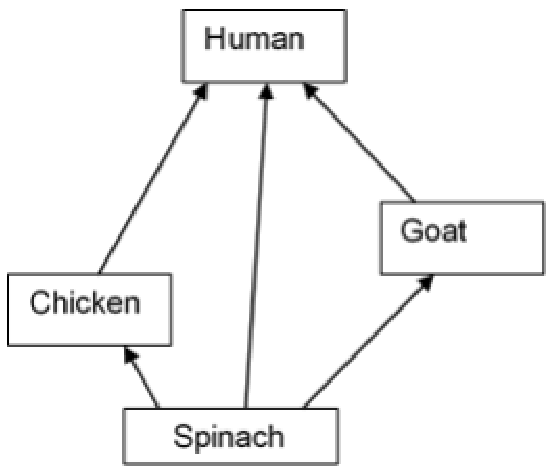
A food web is shown. Which food chain from this web has the most efficient transfer of energy to the human?

Figure from the question paper for: A food web is shown. Which food chain from this web has the most efficient transfer of ene
  1. (A) Spinach → Human
  2. (B) Spinach → Goat → Human
  3. (C) Spinach → Chicken → Human
  4. (D) Human → Spinach
Step-marked solution
  1. [1 mark] Spinach → Human — the shortest chain has the fewest trophic levels, so the least energy is lost before reaching the human.
3 marksSection C

In periods of high rainfall, fertiliser can flow into lake ecosystems. Explain what is meant by the term ecosystem.

Step-marked solution
  1. [1 mark] An ecosystem consists of all the living organisms (plants, animals, microorganisms) living together in an area/habitat.
  2. [1 mark] These organisms interact with one another (biotic interactions).
  3. [1 mark] They also interact with their non-living surroundings (abiotic factors such as water, light, temperature, soil).
4 marksSection E

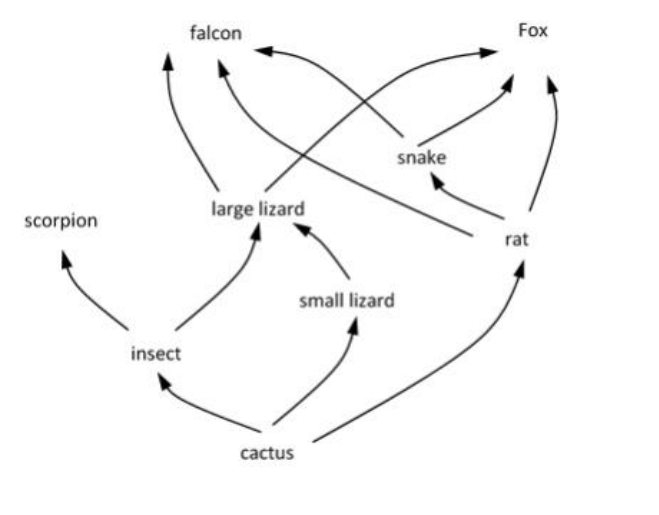
Discuss the impact of pesticides on the desert food web shown in Fig. 1.

Figure from the question paper for: Discuss the impact of pesticides on the desert food web shown in Fig. 1.
Step-marked solution
  1. [1 mark] Pesticides kill the insects (primary consumers), reducing their numbers in the web.
  2. [1 mark] With fewer insects there is less food for the scorpion / large lizard, so these secondary consumers decline, giving less food for the fox / falcon.
  3. [1 mark] The pesticide passes along the chain and bioaccumulates in the top predators (falcon / fox), reaching toxic levels that can damage them and their offspring.
  4. [1 mark] Removing insects also means less damage to the cacti and more plant food for small lizards / rats, so populations of consumers across the web change.
Practise Our Environment competency questions

Read NCERT Chapter 13 on LazyTopper (jesc113)

Official NCERT chapter PDF (jesc113) — ncert.nic.in

Sources: NCERT 2026-27 (tap to view)
Source ledger PROVENANCE

Source edition: NCERT Reprint 2026-27, Class 10 Science, Ch 13. One row per sourced item — every verbatim, example and NCERT figure traces to its page.

ItemTypeSource
EcosystemverbatimNCERT 2026-27 Ch13
ProducersverbatimNCERT 2026-27 Ch13
ConsumersverbatimNCERT 2026-27 Ch13
DecomposersverbatimNCERT 2026-27 Ch13
Trophic levelverbatimNCERT 2026-27 Ch13
Biological magnificationverbatimNCERT 2026-27 Ch13
OzoneverbatimNCERT 2026-27 Ch13
Food webverbatimNCERT 2026-27 Ch13
Chlorofluorocarbons (CFCs)verbatimNCERT 2026-27 Ch13
BiodegradableverbatimNCERT 2026-27 Ch13
Non-biodegradableverbatimNCERT 2026-27 Ch13
Tracing energy along a food chain (10% law)exampleNCERT 2026-27 Ch13 Section 13.1.1
How biological magnification concentrates up the food chainexampleNCERT 2026-27 Ch13 Section 13.1.1
How ozone forms in the upper atmosphere and how it is depletedexampleNCERT 2026-27 Ch13 Section 13.2.1
The fate of biodegradable vs non-biodegradable wasteexampleNCERT 2026-27 Ch13 Section 13.2.2
NCERT Fig 13.1figureNCERT 2026-27 Ch13 13.1
NCERT Fig 13.2figureNCERT 2026-27 Ch13 13.2
NCERT Fig 13.3figureNCERT 2026-27 Ch13 13.3
NCERT Fig 13.4figureNCERT 2026-27 Ch13 13.4

Our Environment · spec-rendered note · NCERT Reprint 2026-27, Class 10 Science, Ch 13

Practise writing answers the way examiners mark them → Guide