Acids Bases & Salts Topic Hub

Acids Bases & Salts — Class 10 Notes

CBSE 2027 — dates, rules and official papers →
Chemistry · Ch 2Class 10 · CBSE 2026–27High weightage

Acids, Bases and Salts

What the board actually asks: identify an acid or a base with indicators (blue/red litmus, methyl orange, phenolphthalein, and olfactory indicators); write and balance the reactions of acids and bases - with metals (Salt + Hydrogen), with metal carbonates/hydrogencarbonates (Salt + Carbon dioxide + Water), acid-base neutralisation (Salt + Water), and metal-oxide / non-metal-oxide reactions; explain what happens to an acid or a base in water (/ and ions) and why their solutions conduct electricity; use the pH scale (0-14) and its everyday importance (body pH, soil, digestion and antacids, tooth decay, acid rain); classify salts by family and by the pH of the salt; and give the preparation, properties and uses of the chlor-alkali products, washing soda, baking soda, bleaching powder and plaster of Paris (water of crystallisation). Most marks sit in writing the correct balanced reaction and in the pH reasoning.

NCERT VERBATIM sourced, word-for-wordAUTHORED LazyTopper teaching scaffolding
The Big Idea AUTHORED

Sour or bitter - decoded by , and pH.

Acids taste sour and turn blue litmus red; bases taste bitter and turn red litmus blue. In water an acid releases hydrogen ions, (shown as the hydronium ion ), and a base releases hydroxide ions, - and those ions explain everything else: why acid and base solutions conduct electricity, how they react with metals, carbonates and each other, and where a solution sits on the pH scale from 0 to 14. When an acid neutralises a base you get a salt plus water, and the chapter then follows one salt - common salt - as it becomes sodium hydroxide, bleaching powder, baking soda and washing soda, then closes with plaster of Paris (made from gypsum).

Formulae
Acid + Metal
Tip: Test hydrogen: it burns with a "pop".
Carbonate / bicarbonate + Acid
Metal carbonate / hydrogencarbonate + Acid → Salt + Carbon dioxide + Water
Tip: CO₂ turns lime water milky.
Neutralisation
·
Tip: Acid + base → salt + water.
Acids / bases in water
·
Tip: An acid shows H⁺ only in water.

pH Scale

pH scale
0 (very acidic) — 7 (neutral) — 14 (very alkaline) ; lower pH = more
Tip: Lower pH = more H⁺.
Chlor-alkali
Tip: Three products: NaOH, Cl₂, H₂.
Baking / washing soda
(baking soda) · (washing soda)
Tip: NaHCO₃ has no water of crystallisation; washing soda has 10.
Plaster of Paris
(gypsum)
Tip: Store away from moisture.
Acid-Base Indicators
Litmus: acids turn blue litmus red; bases turn red litmus blue. Phenolphthalein turns pink with a base. Turmeric is another natural indicator.
Olfactory Indicators
Substances whose smell changes in acidic or basic solutions are olfactory indicators. Onion, vanilla essence and clove oil can be used as olfactory indicators.
pH of Common Substances
pH paper colours give a rough guide; neutral is 7, below 7 is acidic and above 7 is basic. A universal indicator is a mixture of several indicators. From the pH chart: gastric juice about 1.2; lemon juice about 2.2; pure water 7 (neutral); blood about 7.4; milk of magnesia 10; sodium hydroxide solution about 14. Rain with pH below 5.6 is acid rain; our body works within pH 7.0 to 7.8.
pH in Everyday Life
Tooth decay starts when the pH of the mouth falls below 5.5. Antacids neutralise excess acid in the stomach. Acid rain flowing into rivers lowers their pH and makes life difficult for aquatic organisms.
Dilution of Acids and Bases
Always add acid slowly to water with constant stirring; never add water to acid. Dissolving an acid or a base in water is highly exothermic.
pH of Salts
Salts of a strong acid and a strong base are neutral, with pH 7. Salts of a strong acid and a weak base are acidic (pH less than 7). Salts of a strong base and a weak acid are basic (pH more than 7).
Water of Crystallisation
Some crystals contain a fixed number of water molecules, called water of crystallisation: is blue and turns white on heating; moisten it and the blue returns. Washing soda is and gypsum is .
Uses of Sodium Hydroxide, Bleaching Powder, Baking Soda, Washing Soda
Sodium hydroxide (chlor-alkali process, Fig 2.8): de-greasing metals, soaps and detergents, paper making, artificial fibres.
Chlorine: water treatment, swimming pools, PVC, disinfectants, CFCs, pesticides. Hydrogen: fuels, margarine, ammonia for fertilisers.
Bleaching powder: bleaching cotton, linen, wood pulp and washed clothes; an oxidising agent in many chemical industries; makes drinking water free from germs.
Baking soda: baking powder (baking soda + tartaric acid) makes bread and cake rise; crispy pakoras in the kitchen; an ingredient in antacids; soda-acid fire extinguishers.
Washing soda: glass, soap and paper industries; making sodium compounds such as borax; a domestic cleaning agent; removing permanent hardness of water.
Strong and Weak Acids and Bases
The strength of an acid or base depends on the number of H⁺ or OH⁻ ions it gives. Acids that give more H⁺ ions are strong acids; those that give fewer are weak acids. The same idea holds for strong and weak bases.
Definitions the board rewards NCERT VERBATIM

State these in NCERT’s exact words

Acid-base indicators
NCERT verbatim — memorise this exact wording· Ch 2,
“Acid-base indicators are dyes or mixtures of dyes which are used to indicate the presence of acids and bases.”
What it means: Substances that signal whether something is acidic or basic by changing colour - litmus, methyl orange and phenolphthalein are the common ones.
Olfactory indicators
NCERT verbatim — memorise this exact wording· Ch 2,
“There are some substances whose odour changes in acidic or basic media. These are called olfactory indicators.”
What it means: Indicators you smell rather than see - onion and clove oil lose their smell in one medium, so they can flag an acid or a base.
Neutralisation reaction
NCERT verbatim — memorise this exact wording· Ch 2,
“The reaction between an acid and a base to give a salt and water is known as a neutralisation reaction.”
What it means: Acid and base cancel each other out, producing a salt and water: Acid + Base Salt + Water.
Alkali
NCERT verbatim — memorise this exact wording· Ch 2,
“Bases which are soluble in water are called alkalis.”
What it means: A base that dissolves in water - like NaOH or KOH. All alkalis are bases, but not every base is an alkali.
pH scale
NCERT verbatim — memorise this exact wording· Ch 2,
“A scale for measuring hydrogen ion concentration in a solution, called pH scale has been developed.”
What it means: A 0-14 number line for how acidic or basic a solution is: 0 very acidic, 7 neutral, 14 very alkaline. The higher the concentration, the lower the pH.
Strong and weak acids
NCERT verbatim — memorise this exact wording· Ch 2,
“Acids that give rise to more H+ ions are said to be strong acids, and acids that give less H+ ions are said to be weak acids.”
What it means: Strength is about how fully an acid ionises, not how dilute it is - a strong acid produces more ions than a weak acid of the same concentration.
pH of salts
NCERT verbatim — memorise this exact wording· Ch 2,
“Salts of a strong acid and a strong base are neutral with pH value of 7. On the other hand, salts of a strong acid and weak base are acidic with pH value less than 7 and those of a strong base and weak acid are basic in nature, with pH value more than 7.”
What it means: The salt inherits the stronger partner: strong+strong = neutral (7); strong acid + weak base = acidic (<7); strong base + weak acid = basic (>7).
Water of crystallisation
NCERT verbatim — memorise this exact wording· Ch 2,
“Water of crystallisation is the fixed number of water molecules present in one formula unit of a salt.”
What it means: The water locked into a crystal - has five, has ten; heating drives it off (blue copper sulphate turns white).
Dilution
NCERT verbatim — memorise this exact wording· Ch 2,
“Mixing an acid or base with water results in decrease in the concentration of ions (H3O+/OH–) per unit volume. Such a process is called dilution and the acid or the base is said to be diluted.”
What it means: Adding water lowers the ion concentration. Always add the acid to water slowly with stirring - the process is highly exothermic.
Key terms — NCERT verbatim (state word-for-word)
Family of salts
Salts having the same positive or negative radicals are said to belong to a family. (Ch 2, )
Universal indicator
The universal indicator shows different colours at different concentrations of hydrogen ions in a solution. (Ch 2, )
Acid rain
When pH of rain water is less than 5.6, it is called acid rain. (Ch 2, )
Chlor-alkali process
The process is called the chlor-alkali process because of the products formed– chlor for chlorine and alkali for sodium hydroxide. (Ch 2, )
Bleaching powder
Bleaching powder is produced by the action of chlorine on dry slaked lime [Ca(OH)2]. (Ch 2, )
Plaster of Paris
Plaster of Paris is a white powder and on mixing with water, it changes to gypsum once again giving a hard solid mass. (Ch 2, )
Must-know concepts AUTHORED FRAMING

…and where they’re tested

Testing acids and bases with indicators
Indicators change colour (or odour) in acidic and basic media. Blue litmus turns red in an acid; red litmus turns blue in a base. Methyl orange and phenolphthalein are synthetic indicators (phenolphthalein is colourless in acid, pink in base), and substances whose smell changes - onion, vanilla and clove oil - are olfactory indicators.
1-2 mark: name an indicator and its colour change; identify three test tubes (acid / base / distilled water) using only red litmus paper.
Reactions of acids and bases
Acids react with metals to give a salt and hydrogen gas; with metal carbonates and hydrogencarbonates to give a salt, carbon dioxide and water; and with bases in a neutralisation reaction to give a salt and water. Metal oxides are basic (they react with acids to give salt and water), while non-metal oxides are acidic (they react with bases).
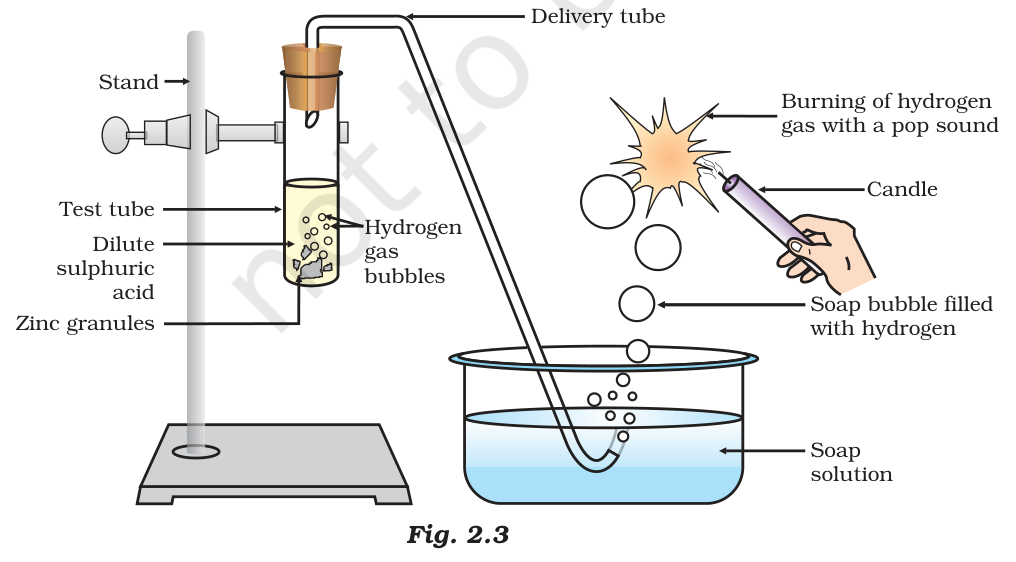
NCERT Fig 2.1Reaction of zinc granules with dilute sulphuric acid and testing hydrogen gas by burning.
Acid + metal: zinc reacts with dilute sulphuric acid to give hydrogen gas, which burns with a pop sound. Labels: stand, test tube, dilute sulphuric acid, zinc granules, hydrogen gas bubbles, delivery tube, soap solution, soap bubble filled with hydrogen, candle, burning of hydrogen gas with a pop sound.
3-5 mark: write and balance the reaction, name the salt and the gas, and describe the test for the gas evolved.
What all acids and all bases have in common
All acids produce hydrogen ions, - shown as the hydronium ion - but only in the presence of water; all bases produce hydroxide ions, . These free ions carry current, so acid and base solutions conduct electricity, whereas glucose and alcohol contain hydrogen yet do not ionise and do not conduct.
2 mark: why dry HCl gas does not turn dry litmus red; why an aqueous acid conducts electricity while glucose solution does not.
Strength and the pH scale
Strength depends on how many (or ) ions a solution produces, not on how concentrated it is - a strong acid ionises more fully than a weak acid at the same concentration. The universal indicator and the pH scale (0 very acidic, 7 neutral, 14 very alkaline) measure hydrogen-ion concentration: the higher the concentration, the lower the pH.
NCERT Fig 2.6Variation of pH with the change in concentration of and ions.
The pH scale runs 0 to 14: acidic nature increases towards 0 (rising ), basic nature increases towards 14 (rising ), and 7 is neutral. Labels: acidic nature increasing, neutral 7, basic nature increasing, , , increase / decrease in ion concentration.
2-3 mark: order solutions by pH / concentration; classify solutions as strong or weak, acidic or basic.
Importance of pH in everyday life
Living things survive in a narrow pH band (our body works around 7.0-7.8). Soil needs a suitable pH for healthy plants; the stomach uses hydrochloric acid for digestion, and antacids (mild bases such as milk of magnesia) neutralise excess acid; tooth decay begins when the mouth pH falls below 5.5; rain below pH 5.6 is acid rain. Bee and nettle stings are acidic and are soothed with a mild base like baking soda.
2-3 mark: why antacids relieve indigestion; why tooth-cleaning is basic; acid rain / treating soil with lime.
Salts - family and pH
A salt is formed when an acid neutralises a base. Salts with the same positive or negative radical belong to one family (NaCl and are sodium salts; NaCl and KCl are chloride salts). A salt of a strong acid and a strong base is neutral (pH 7); a strong-acid / weak-base salt is acidic (pH < 7); and a strong-base / weak-acid salt is basic (pH > 7).
identify the acid and base a salt came from; predict whether the salt is acidic, basic or neutral.
Chemicals from common salt, and water of crystallisation
Common salt (NaCl) is the raw material for many chemicals. Electrolysis of brine - the chlor-alkali process - gives sodium hydroxide, chlorine and hydrogen. Chlorine on dry slaked lime gives bleaching powder, . Baking soda () and washing soda () are both made from common salt, and heating gypsum at 373 K gives plaster of Paris. Water of crystallisation is the fixed number of water molecules in one formula unit of a salt (, , ).
NCERT Fig 2.8Important products from the chlor-alkali process.
Electrolysis of brine (aqueous NaCl) gives chlorine at the anode, hydrogen at the cathode and sodium hydroxide near the cathode, separated by a membrane. Labels: anode (+), cathode (-), , , brine, brine containing NaOH, membrane, , , , , and the uses of each product.
3-5 mark: uses of the chlor-alkali products; equations for baking soda, washing soda and plaster of Paris; what signifies.
Worked examples — real solved problems NCERT VERBATIM

Solved exactly as the source does them

Every problem is a real sourced item, quoted verbatim with its page; the step-by-step decoding and mark-logic are LazyTopper-authored coaching.

Ch 2, Example Activity 2.3 / Exercise 5(a),
“[authored prompt] Dilute sulphuric acid is added to zinc granules. Write the word equation and the balanced chemical equation, and name and test the gas evolved.”
Word equation.Zinc + dilute sulphuric acid zinc sulphate + hydrogen.Concept: Acid + Metal Salt + Hydrogen
1 mark
Balanced equation.The metal displaces hydrogen from the acid:
1 mark
Name and test the gas.The gas is hydrogen; when a burning candle is brought near a hydrogen-filled soap bubble it burns with a pop sound.
1 mark
Mark-scheme logic (authored): CBSE 3-mark: correct word equation (1) + balanced chemical equation with state symbols (1) + naming hydrogen and its pop-sound test (1).
Ch 2, Example Section 2.1.3 + Questions,
“[authored prompt] A metal compound A reacts with dilute hydrochloric acid to give effervescence; the gas evolved extinguishes a burning candle, and one of the products is calcium chloride. Identify A, write the balanced equation, and name the gas.”
Ch 2, Example Activity 2.6, Section 2.1.4,
“[authored prompt] Dilute hydrochloric acid is added drop by drop to sodium hydroxide solution containing phenolphthalein. Write the balanced equation, classify the reaction, and give it in ionic form.”
Ch 2, Example Exercise Q3,
“[authored prompt] 10 mL of a NaOH solution is exactly neutralised by 8 mL of a given HCl solution. What volume of the same HCl solution is needed to neutralise 20 mL of the same NaOH solution?”
Problem-solving strategies AUTHORED
Acid or base?Reach for an indicator first - blue litmus red = acid, red litmus blue = base; phenolphthalein stays colourless in acid and turns pink in base.
Reaction asked?Match the second reactant: metal Salt + ; carbonate / hydrogencarbonate Salt + + Water; base Salt + Water (neutralisation); metal oxide is basic, non-metal oxide is acidic. Then balance and add state symbols.
Test the gas.Hydrogen burns with a pop sound; carbon dioxide turns lime water milky and puts out a flame - name the gas by its test.
pH question?Lower pH means more and more acidic; exactly 7 is neutral. To compare two solutions, the one with the lower pH has the higher hydrogen-ion concentration.
A chemical from common salt?Anchor each to NaCl: brine (chlor-alkali); + dry slaked lime bleaching powder; heat gypsum plaster of Paris.
Common mistakes that cost marks

Where students lose easy marks

Thinking 'salt' means only sodium chloride. In chemistry a salt is any product of an acid neutralising a base - , and are all salts.
Forgetting that ions form only in water, so dry HCl gas does NOT turn dry litmus red - the separation of from the HCl molecule needs water.
Confusing strength with concentration. A strong acid ionises more fully than a weak acid at the same concentration; strong / weak is about the number of ions produced, not how dilute the solution is.
Adding water to a concentrated acid. Always add the acid to water slowly with stirring - dissolving an acid or base is highly exothermic and the mixture can splash out.
Mixing up baking soda and washing soda - baking soda is (sodium hydrogencarbonate) while washing soda is (hydrated sodium carbonate).
Writing plaster of Paris with a whole water molecule. It is calcium sulphate hemihydrate, - two formula units share one water molecule.
Formulae
Acid + Metal
Tip: Test hydrogen: it burns with a "pop".
Carbonate / bicarbonate + Acid
Metal carbonate / hydrogencarbonate + Acid → Salt + Carbon dioxide + Water
Tip: CO₂ turns lime water milky.
Neutralisation
·
Tip: Acid + base → salt + water.
Acids / bases in water
·
Tip: An acid shows H⁺ only in water.

pH Scale

pH scale
0 (very acidic) — 7 (neutral) — 14 (very alkaline) ; lower pH = more
Tip: Lower pH = more H⁺.
Chlor-alkali
Tip: Three products: NaOH, Cl₂, H₂.
Baking / washing soda
(baking soda) · (washing soda)
Tip: NaHCO₃ has no water of crystallisation; washing soda has 10.
Plaster of Paris
(gypsum)
Tip: Store away from moisture.
Acid-Base Indicators
Litmus: acids turn blue litmus red; bases turn red litmus blue. Phenolphthalein turns pink with a base. Turmeric is another natural indicator.
Olfactory Indicators
Substances whose smell changes in acidic or basic solutions are olfactory indicators. Onion, vanilla essence and clove oil can be used as olfactory indicators.
pH of Common Substances
pH paper colours give a rough guide; neutral is 7, below 7 is acidic and above 7 is basic. A universal indicator is a mixture of several indicators. From the pH chart: gastric juice about 1.2; lemon juice about 2.2; pure water 7 (neutral); blood about 7.4; milk of magnesia 10; sodium hydroxide solution about 14. Rain with pH below 5.6 is acid rain; our body works within pH 7.0 to 7.8.
pH in Everyday Life
Tooth decay starts when the pH of the mouth falls below 5.5. Antacids neutralise excess acid in the stomach. Acid rain flowing into rivers lowers their pH and makes life difficult for aquatic organisms.
Dilution of Acids and Bases
Always add acid slowly to water with constant stirring; never add water to acid. Dissolving an acid or a base in water is highly exothermic.
pH of Salts
Salts of a strong acid and a strong base are neutral, with pH 7. Salts of a strong acid and a weak base are acidic (pH less than 7). Salts of a strong base and a weak acid are basic (pH more than 7).
Water of Crystallisation
Some crystals contain a fixed number of water molecules, called water of crystallisation: is blue and turns white on heating; moisten it and the blue returns. Washing soda is and gypsum is .
Uses of Sodium Hydroxide, Bleaching Powder, Baking Soda, Washing Soda
Sodium hydroxide (chlor-alkali process, Fig 2.8): de-greasing metals, soaps and detergents, paper making, artificial fibres.
Chlorine: water treatment, swimming pools, PVC, disinfectants, CFCs, pesticides. Hydrogen: fuels, margarine, ammonia for fertilisers.
Bleaching powder: bleaching cotton, linen, wood pulp and washed clothes; an oxidising agent in many chemical industries; makes drinking water free from germs.
Baking soda: baking powder (baking soda + tartaric acid) makes bread and cake rise; crispy pakoras in the kitchen; an ingredient in antacids; soda-acid fire extinguishers.
Washing soda: glass, soap and paper industries; making sodium compounds such as borax; a domestic cleaning agent; removing permanent hardness of water.
Strong and Weak Acids and Bases
The strength of an acid or base depends on the number of H⁺ or OH⁻ ions it gives. Acids that give more H⁺ ions are strong acids; those that give fewer are weak acids. The same idea holds for strong and weak bases.
Shortcuts & Tricks
pH < 7 acid, 7 neutral, > 7 base; lower pH = more H⁺.
MCQ / check only: don't write this as working
Gas that turns lime water milky = CO₂; in an acid reaction, the other reactant is a carbonate or hydrogencarbonate.
MCQ / check only: don't write this as working
Dilute acids by adding acid to water.
Safe in written answers
Salt of strong acid + strong base is neutral (NaCl, pH 7).
MCQ / check only: don't write this as working
Burning matchstick near the gas: "pop" ⇒ hydrogen.
MCQ / check only: don't write this as working
Dry HCl gas does not change dry litmus; acids show acidic behaviour only in water (H⁺(aq)).
Safe in written answers
Memory Tricks
Acid ne Neela ko Laal kiya; Base ne Laal ko Neela.
Litmus. acid: blue → red; base: red → blue.
0 sabse khatta, 7 beech ka paani, 14 sabse kadwa (saabun jaisa).
pH scale. 0 very acidic · 7 neutral · 14 very alkaline.
Baking soda mein Hydrogen, washing soda mein dus paani.
Formulae. baking soda NaHCO₃ (H, no crystal water); washing soda Na₂CO₃·10H₂O.
Aadha paani wala POP, do paani wala Gypsum.
CaSO₄ hydrates. POP CaSO₄·½H₂O; gypsum CaSO₄·2H₂O.
Naina Chai Hi: NaOH, Cl₂, H₂.
Products of brine electrolysis. N = NaOH · C = Cl₂ · H = H₂ (order of the NCERT equation).
Majboot acid + majboot base = namak, pH 7.
Salt types. strong acid + strong base → neutral salt.
Paani mein acid, kabhi acid mein paani nahi.
Safe dilution. add acid to water.
Mindmap
      • Litmus: blue red (acid), red blue (base)
      • Methyl orange & phenolphthalein
      • Olfactory: onion, vanilla, clove
      • Universal indicator pH
      • Acid + Metal Salt +
      • Carbonate / bicarbonate + Acid Salt + + Water
      • Neutralisation: Acid + Base Salt + Water
      • Metal oxide (basic) + Acid
      • Non-metal oxide (acidic) + Base
      • Acid /
      • Base ; alkali = soluble base
      • Free ions conduct electricity
      • Dilution is highly exothermic
      • 7 neutral, <7 acidic, >7 basic
      • Strong vs weak (more / less )
      • Body 7.0-7.8; tooth decay < 5.5
      • Acid rain < 5.6; soil & digestion
      • Salt = acid + base neutralised
      • Family: same radical
      • pH of salt: strong+strong = 7
      • Water of crystallisation ()
      • Chlor-alkali:
      • Bleaching powder
      • Baking soda
      • Washing soda
      • Plaster of Paris

For Chemistry the subject-adaptive third tab holds the chapter's key reactions - the formal core you must be able to reproduce, grouped by type. Every entry is a real NCERT Ch 2 reaction (word or balanced equation as the book gives it); the condition sits beside the arrow.

Acid + metal (general)
Acid + Metal Salt + Hydrogen gas
The metal displaces hydrogen from the acid as hydrogen gas
Base + metal (zinc + sodium hydroxide)
Warmed; sodium zincate forms and hydrogen is evolved (not all metals do this)
Carbonate + acid (sodium carbonate + HCl)
Effervescence of carbon dioxide (Activity 2.5)
Hydrogencarbonate + acid (sodium hydrogencarbonate + HCl)
Effervescence of carbon dioxide (Activity 2.5)
Carbon dioxide + lime water
Lime water turns milky (white precipitate of calcium carbonate)
Excess carbon dioxide + calcium carbonate
On passing excess the milkiness disappears (soluble calcium hydrogencarbonate)
Neutralisation (sodium hydroxide + HCl)
Base + Acid Salt + Water (Activity 2.6)
Metal oxide + acid (general)
Metal oxide + Acid Salt + Water
Copper oxide + dilute HCl gives a blue-green copper(II) chloride solution; metal oxides are basic
Neutralisation - ionic form
All acids give and all bases give ; Acid + Base Salt + Water
Acid in water (ionisation of HCl)
ions separate from HCl only in the presence of water (hydronium ion)
Chlor-alkali process (electrolysis of brine)
Electricity through brine; at anode, at cathode, NaOH near the cathode
Bleaching powder
Action of chlorine on dry slaked lime; bleaching powder is
Baking soda (formation)
Sodium hydrogencarbonate made using common salt as a raw material
Baking soda on heating
On heating during cooking; the released makes cakes soft and spongy
Washing soda (recrystallisation)
Sodium carbonate from heating baking soda is recrystallised to hydrated washing soda
Plaster of Paris + water gypsum
Plaster of Paris sets to a hard mass of gypsum on mixing with water

3 competency questions from the CBSE board pattern, with the full step-marked solution for each — the marks are shown per step, as the official scheme awards them.

5 marksSection D

In the following schematic diagram for the preparation of hydrogen gas (Figure 2.3), what would happen if following changes are made? (a) In place of zinc granules, same amount of zinc dust is taken in the test tube (b) Instead of dilute sulphuric acid, dilute hydrochloric acid is taken (c) In place of zinc, copper turnings are taken (d) Sodium hydroxide is taken in place of dilute sulphuric acid and the tube is heated.

Figure from the question paper for: In the following schematic diagram for the preparation of hydrogen gas (Figure 2.3), what
Step-marked solution
  1. [1 mark] (a) Smaller particle size = larger surface area → faster reaction. H₂ evolves more rapidly.
  2. [1 mark] (b) Dilute HCl is a strong acid, Zn above H → Zn + 2HCl → ZnCl₂ + H₂. Same effect — H₂ evolved.
  3. [1 mark] (c) Cu is BELOW H in the reactivity series → Cu cannot displace H from dilute acids. No H₂ evolved, no reaction.
  4. [1 mark] (d) Zinc is amphoteric (reacts with both acid and strong base). With hot NaOH: Zn(s) + 2NaOH(aq) → Na₂ZnO₂(aq) + H₂(g)↑. H₂ is evolved.
  5. [1 mark] Summary: (a) faster; (b) yes H₂; (c) no reaction; (d) yes H₂ (different reaction with sodium zincate formation).
5 marksSection D

For making cake, baking powder is taken. If at home your mother uses baking soda instead of baking powder in cake, (a) how will it affect the taste of the cake and why? (b) how can baking soda be converted into baking powder? (c) what is the role of tartaric acid added to baking soda?

Step-marked solution
  1. [1 mark] (a) Baking soda alone in cake: heating → 2NaHCO₃ → Na₂CO₃ + H₂O + CO₂. The leftover Na₂CO₃ is basic and tastes bitter. So cake becomes bitter.
  2. [1 mark] (b) Baking powder = baking soda (NaHCO₃) + a mild edible acid (tartaric acid).
  3. [1 mark] (c) Tartaric acid neutralises Na₂CO₃ formed on heating: Na₂CO₃ + tartaric acid → sodium tartarate (tasteless salt) + H₂O + CO₂.
  4. [1 mark] (c) This prevents bitterness AND releases additional CO₂ → cake rises and becomes spongy.
  5. [1 mark] (c) Overall, tartaric acid plays a dual role: taste correction + extra leavening.
5 marksSection D

A metal carbonate X on reacting with an acid gives a gas which when passed through a solution Y gives the carbonate back. On the other hand, a gas G that is obtained at anode during electrolysis of brine is passed on dry Y, it gives a compound Z, used for disinfecting drinking water. Identify X, Y, G and Z.

Step-marked solution
  1. [1 mark] Gas from metal carbonate + acid = CO₂.
  2. [1 mark] CO₂ + Y gives carbonate back → Y is Ca(OH)₂ (lime water): CO₂ + Ca(OH)₂ → CaCO₃ + H₂O. The carbonate formed is CaCO₃ → so X = CaCO₃.
  3. [0.5 mark] Electrolysis of brine: anode gives Cl₂, cathode gives H₂. So G = Cl₂.
  4. [0.5 mark] Cl₂ + dry slaked lime: Ca(OH)₂ + Cl₂ → CaOCl₂ + H₂O. Z = CaOCl₂.
  5. [1 mark] CaOCl₂ is bleaching powder, used as a disinfectant for drinking water.
  6. [1 mark] Summary: X = CaCO₃, Y = Ca(OH)₂, G = Cl₂, Z = CaOCl₂.
Practise Acids, Bases and Salts competency questions

Read NCERT Chapter 2 on LazyTopper (jesc102)

Official NCERT chapter PDF (jesc102) — ncert.nic.in

Sources: NCERT 2026-27 (tap to view)
Source ledger PROVENANCE

Source edition: NCERT Reprint 2026-27, Class 10 Science, Ch 2. One row per sourced item — every verbatim, example and NCERT figure traces to its page.

ItemTypeSource
Acid-base indicatorsverbatimNCERT 2026-27 Ch2
Olfactory indicatorsverbatimNCERT 2026-27 Ch2
Neutralisation reactionverbatimNCERT 2026-27 Ch2
AlkaliverbatimNCERT 2026-27 Ch2
pH scaleverbatimNCERT 2026-27 Ch2
Strong and weak acidsverbatimNCERT 2026-27 Ch2
pH of saltsverbatimNCERT 2026-27 Ch2
Water of crystallisationverbatimNCERT 2026-27 Ch2
DilutionverbatimNCERT 2026-27 Ch2
Family of saltsverbatimNCERT 2026-27 Ch2
Universal indicatorverbatimNCERT 2026-27 Ch2
Acid rainverbatimNCERT 2026-27 Ch2
Chlor-alkali processverbatimNCERT 2026-27 Ch2
Bleaching powderverbatimNCERT 2026-27 Ch2
Plaster of ParisverbatimNCERT 2026-27 Ch2
Acid + metal salt + hydrogenexampleNCERT 2026-27 Ch2 Activity 2.3 / Exercise 5(a)
Metal carbonate + acid salt + + waterexampleNCERT 2026-27 Ch2 Section 2.1.3 / Questions
Neutralisation (acid + base)exampleNCERT 2026-27 Ch2 Activity 2.6 / Section 2.1.4
Neutralisation volume ratioexampleNCERT 2026-27 Ch2 Exercise Q3
NCERT Fig 2.1figureNCERT 2026-27 Ch2 Fig 2.1
NCERT Fig 2.6figureNCERT 2026-27 Ch2 Fig 2.6
NCERT Fig 2.8figureNCERT 2026-27 Ch2 Fig 2.8

Acids, Bases and Salts · spec-rendered note · NCERT Reprint 2026-27, Class 10 Science, Ch 2

Practise writing answers the way examiners mark them → Guide