What the board actually asks:surface area and volume of a COMBINATION of solids — cone-on-hemisphere toys, capsules, cylinders with hemispherical ends, a cuboid surmounted by a half-cylinder. Break the object into the basic solids you already know (cuboid, cube, cylinder, cone, sphere, hemisphere), add only the EXPOSED areas for surface area, and simply ADD the volumes.
Every object in this chapter is two basic solids stuck together. Nothing new to memorise — you already know the surface areas and volumes of the cuboid, cube, cylinder, cone, sphere and hemisphere from Class IX. The whole skill is: see the pieces, then combine them by two rules. For surface area, add only the faces you can still see (the join hides some area). For volume, just add the pieces up (nothing disappears).
Formulae
Surface Area and Volume of a Cylinder
Cylinder
CSA=2πrh⋅TSA=2πr(r+h)⋅V=πr2h
Tip: CSA = 2πrh; TSA adds two circles.
Surface Area and Volume of a Cone
Cone
CSA=πrl⋅TSA=πr(r+l)⋅V=31πr2h⋅l=r2+h2
Tip: l = √(r² + h²) first.
Surface Area and Volume of a Sphere
Sphere
Surface area=4πr2⋅V=34πr3
Surface Area and Volume of a Hemisphere
Hemisphere
CSA=2πr2⋅TSA=3πr2⋅V=32πr3
Tip: CSA 2πr², TSA 3πr².
Surface Area and Volume of a Cuboid and Cube
Cuboid & Cube
Cuboid TSA=2(lb+bh+hl),V=lbh⋅Cube TSA=6a2,V=a3
Combination rule
Surface: add EXPOSED areas⋅Volume: add the constituents
Tip: Surface: add only the EXPOSED areas (the joined faces disappear). Volume: add the parts.
Surface Area of a Combination of Solids
Rule and common layouts
Add only the exposed curved and flat areas. Cone on a hemisphere: TSA = CSA of hemisphere + CSA of cone. Cylinder with hemispherical ends: CSA of cylinder + two hemisphere CSAs. If a hemisphere or cone is scooped out of a cylinder, subtract the opening πr2 and add the inner curved surface.
Volume of a Combination of Solids
Rule
Volume of a combination = sum of the volumes of the parts. If a solid is scooped out, subtract its volume.
Volume Relations
For the same r and h, a cone is one-third of the cylinder. A hemisphere is half of the sphere.
📖NCERT verbatim — memorise this exact wording· Ch 12,
“the total surface area of the new solid is the sum of the curved surface areas of each of the individual parts.”
What it means:add up only the surfaces you can still SEE after joining — for a cylinder capped by two hemispheres, that is the two curved hemispheres plus the curved cylinder; the flat circular faces vanish inside the join.
Volume of a combination of solids
📖NCERT verbatim — memorise this exact wording· Ch 12,
“The volume of the solid formed by joining two basic solids will actually be the sum of the volumes of the constituents, as we see in the examples below.”
What it means:unlike surface area, volume loses nothing at the join — just ADD the volume of each basic solid. This is the one place where you literally sum the pieces with no subtraction for the shared face.
Why surface areas are not simply added
📖NCERT verbatim — memorise this exact wording· Ch 12,
“in calculating the surface area, we have not added the surface areas of the two constituents, because some part of the surface area disappeared in the process of joining them.”
What it means:when two solids are stuck together, the faces that touch are hidden inside and no longer count. That is exactly why surface area is NOT the plain sum of the two full surface areas.
Total surface area is not additive
📖NCERT verbatim — memorise this exact wording· Ch 12,
“You may note that 'total surface area of the top' is not the sum of the total surface areas of the cone and hemisphere.”
What it means:the sharp warning NCERT prints after Example 1. Do not add TSA(cone) + TSA(hemisphere) — that double-counts the hidden circular base. Add only the exposed curved surfaces.
📖Key terms — NCERT verbatim (state word-for-word)
TSA of a cylinder with two hemispherical ends
TSA of new solid = CSA of one hemisphere + CSA of cylinder + CSA of other hemisphere (Ch 12, )
TSA of a cone-and-hemisphere toy
Total surface area of the toy = CSA of hemisphere + CSA of cone (Ch 12, )
Surface area of a combination (Summary)
To determine the surface area of an object formed by combining any two of the basic solids, namely, cuboid, cone, cylinder, sphere and hemisphere. (Ch 12, )
Volume of a combination (Summary)
To find the volume of objects formed by combining any two of a cuboid, cone, cylinder, sphere and hemisphere. (Ch 12, )
Combination of solids
we come across a number of solids made up of combinations of two or more of the basic solids (Ch 12, )
Must-know concepts AUTHORED FRAMING
…and where they’re tested
1
Break a combination into basic solids
Every object here is two basic solids joined at a shared face. Name the pieces first — e.g. a medicine capsule is a cylinder with a hemisphere on each end; a toy top is a cone surmounted by a hemisphere. Once you can see the pieces, all the formulas are ones you already know.
NCERT Fig. 12.10Medicine capsule - a cylinder with a hemisphere stuck to each end; length 14 mm, diameter 5 mm.
The straight middle is the cylinder; the two rounded ends are the hemispheres. Surface = curved cylinder + two curved hemispheres.
the setup mark on essentially every combination-solid question
2
Surface area = only the EXPOSED faces
Add the curved (and any still-visible flat) surfaces that remain after joining; drop the faces hidden inside the join. Never add the two full total surface areas — that double-counts the buried circle. When a solid is scooped out, the removed curved surface is added and the flat opening is handled carefully.
2-3 mark 'find the surface area / area to be painted' problems
3
Volume = simply ADD the constituents
Volume is the friendly rule: the volume of the joined solid is the plain sum of the pieces' volumes, because no volume is lost at the join. For a scooped/hollow solid, subtract the volume of the removed piece.
3-5 mark volume and capacity problems
4
The cone's slant height comes first
Any combination with a cone needs its curved surface area πrl, which needs the slant height l=r2+h2. Compute l BEFORE the CSA. And the cone's height is usually the whole solid's height minus the attached hemisphere's radius, not the whole height.
any combination containing a cone (toy top, tent, rocket)
5
Capacity, and hollowed / scooped solids
When a hemisphere is scooped out of a cylinder (a glass, a bird-bath), the capacity drops by the removed hemisphere's volume, while the surface gains the hemisphere's curved area in place of a flat lid. Read whether the question wants apparent capacity or actual capacity.
capacity and 'surface area of the remaining solid' problems
Worked examples — real solved problems NCERT VERBATIM
Solved exactly as the source does them
Every problem is a real sourced item, quoted verbatim with its page; the step-by-step decoding and mark-logic are LazyTopper-authored coaching.
Ch 12, Example 1,
“Rasheed got a playing top (lattu) as his birthday present, which surprisingly had no colour on it. He wanted to colour it with his crayons. The top is shaped like a cone surmounted by a hemisphere (see Fig 12.6). The entire top is 5 cm in height and the diameter of the top is 3.5 cm. Find the area he has to colour. (Take π = 22/7)”
1
Use the combination result.TSA of the toy=CSA of hemisphere+CSA of cone — only the two curved surfaces are exposed.Concept: exposed surfaces only
½ mark
2
Read the dimensions.Radius r=23.5=1.75 cm. Height of the cone =5−1.75=3.25 cm (subtract the hemisphere's radius from the total height).Concept: cone height = total minus hemisphere radius
½ mark
3
Slant height first.l=r2+h2=1.752+3.252≈3.7 cm.Concept: slant height before CSA
1 mark
4
Add the two curved areas.TSA=2πr2+πrl=πr(2r+l)=211(3.5+3.7)=39.6cm2 (approx.).Concept: sum of curved areas
1 mark
Mark-scheme logic (authored):3-mark shape: 0.5 for the combination result (only the curved surfaces show), 0.5 for the correct cone height (whole height minus the hemisphere's radius), 1 for the slant height, 1 for adding the two curved areas to 39.6 cm². Classic lost mark: using 5 cm as the cone's height.
Ch 12, Example 4,
“Mayank made a bird-bath for his garden in the shape of a cylinder with a hemispherical depression at one end (see Fig. 12.9). The height of the cylinder is 1.45 m and its radius is 30 cm. Find the total surface area of the bird-bath. (Take π = 22/7)”
Ch 12, Example 5,
“Shanta runs an industry in a shed which is in the shape of a cuboid surmounted by a half cylinder (see Fig. 12.12). If the base of the shed is of dimension 7 m × 15 m, and the height of the cuboidal portion is 8 m, find the volume of air that the shed can hold. Further, suppose the machinery in the shed occupies a total space of 300 m³, and there are 20 workers, each of whom occupy about 0.08 m³ space on an average. Then, how much air is in the shed? (Take π = 22/7)”
Ch 12, Example 7,
“A solid toy is in the form of a hemisphere surmounted by a right circular cone. The height of the cone is 2 cm and the diameter of the base is 4 cm. Determine the volume of the toy. If a right circular cylinder circumscribes the toy, find the difference of the volumes of the cylinder and the toy. (Take π = 3.14)”
Problem-solving strategies AUTHORED
→
New shape you can't name?Break it into two basic solids (cuboid, cube, cylinder, cone, sphere, hemisphere) — every object here is a combination of ones you already know.
→
Surface area?Add only the EXPOSED faces. Drop the circles hidden at the join; never add the two full total surface areas.
→
Volume?Simply ADD the pieces' volumes. For a scooped/hollow solid, subtract the removed piece.
→
A cone is involved?Find the slant height l=r2+h2 first, and take the cone's height as the whole height minus the attached hemisphere's radius.
→
Units differ (m and cm)?Convert everything to one unit BEFORE substituting — a mixed-unit substitution is a guaranteed lost mark.
Common mistakes that cost marks
Where students lose easy marks
✕
Adding the two full surface areas — TSA of a combination is NOT TSA(part 1) + TSA(part 2); the buried join circle is double-counted. Add only the exposed curved/flat areas.
✕
Wrong cone height — for a cone on a hemisphere, the cone's height is the total height minus the hemisphere's radius, not the whole height.
✕
Mixing units — combining a 1.45 m height with a 30 cm radius without converting. Bring everything to one unit first.
✕
Subtracting for volume — volumes of joined solids simply ADD; nothing disappears at the join. Only SCOOPED-out solids involve subtraction.
Formulae
Surface Area and Volume of a Cylinder
Cylinder
CSA=2πrh⋅TSA=2πr(r+h)⋅V=πr2h
Tip: CSA = 2πrh; TSA adds two circles.
Surface Area and Volume of a Cone
Cone
CSA=πrl⋅TSA=πr(r+l)⋅V=31πr2h⋅l=r2+h2
Tip: l = √(r² + h²) first.
Surface Area and Volume of a Sphere
Sphere
Surface area=4πr2⋅V=34πr3
Surface Area and Volume of a Hemisphere
Hemisphere
CSA=2πr2⋅TSA=3πr2⋅V=32πr3
Tip: CSA 2πr², TSA 3πr².
Surface Area and Volume of a Cuboid and Cube
Cuboid & Cube
Cuboid TSA=2(lb+bh+hl),V=lbh⋅Cube TSA=6a2,V=a3
Combination rule
Surface: add EXPOSED areas⋅Volume: add the constituents
Tip: Surface: add only the EXPOSED areas (the joined faces disappear). Volume: add the parts.
Surface Area of a Combination of Solids
Rule and common layouts
Add only the exposed curved and flat areas. Cone on a hemisphere: TSA = CSA of hemisphere + CSA of cone. Cylinder with hemispherical ends: CSA of cylinder + two hemisphere CSAs. If a hemisphere or cone is scooped out of a cylinder, subtract the opening πr2 and add the inner curved surface.
Volume of a Combination of Solids
Rule
Volume of a combination = sum of the volumes of the parts. If a solid is scooped out, subtract its volume.
Volume Relations
For the same r and h, a cone is one-third of the cylinder. A hemisphere is half of the sphere.
Shortcuts & Tricks
Cone volume = ⅓ cylinder; hemisphere = ½ sphere.
MCQ / check only: don't write this as working
Cone: h = 3V ÷ (πr²).
MCQ / check only: don't write this as working
Write each exposed face before adding.
Safe in written answers
Take πr² as a common factor before computing.
Safe in written answers
Memory Tricks
Do pie r h (bahar ki chadar); do pie r (r+h) (poora); pie r² h (bhar).
2πrh; 2πr(r+h); πr²h.
Pie r l (chadar); pie r (r+l) (poora); tihai pie r² h (bhar).
πrl; πr(r+l); ⅓πr²h.
Chaar pie r² (chadar); chaar-tihai pie r³ (bhar).
4πr²; ⁴⁄₃πr³.
Do, Teen, Do-tihai.
CSA, TSA, volume of a hemisphere. Do = CSA 2πr² · Teen = TSA 3πr² · Do-tihai = V (2/3)πr³.
Jahan do solid jude, sirf jude hue hisse ka area gayab.
combination rule. joined faces are not exposed.
Mindmap
Add only the EXPOSED faces
Hidden join circles don't count
Not TSA(part 1) + TSA(part 2)
Simply ADD the constituents
Nothing lost at the join
Scooped solid → subtract the removed piece
Cylinder: 2πrh, πr2h
Cone: πrl, 31πr2h
Sphere: 4πr2, 34πr3
Hemisphere: 2πr2, 32πr3
Slant height l=r2+h2 first
Cone height = total - hemisphere radius
Adding the two full surface areas
Wrong cone height
Mixing m and cm
Subtracting for volume
Why the surface area of a combination is a sum of curved areas
This is the core reasoning of the chapter, worked on NCERT's cone-on-hemisphere toy (pp. 162-164). It shows WHY you add only the exposed curved surfaces, and why the total surface area is not the plain sum of the two solids' total surface areas.
1
Whenever we meet a new solid, break it into basic solids we have already solved.
NCERT's method for a combination: reduce the new problem to smaller problems already solved (p.162).
2
Build the toy by bringing the flat face of a cone and the flat face of a hemisphere together, with equal base radii.
The two flat circular faces meet exactly and are sealed inside the join, so neither is on the outside surface (p.163).
3
Only the curved surfaces remain visible, so the surface area is their sum.
TSA of the toy=CSA of hemisphere+CSA of cone=2πr2+πrl
The exposed surface is exactly the curved hemisphere plus the curved cone (p.163).
4
Therefore the total surface area is NOT the sum of the two solids' full total surface areas.
TSA(cone) + TSA(hemisphere) would count the shared base circle twice; NCERT prints this warning after Example 1 (p.164).
5
For volume the same join hides nothing, so volumes simply add.
Vtoy=32πr3+31πr2h
No volume disappears at the join, so the combined volume is the sum of the constituents (p.167).
3 competency questions from the CBSE board pattern, with the full step-marked solution for each — the marks are shown per step, as the official scheme awards them.
2 marksSection B
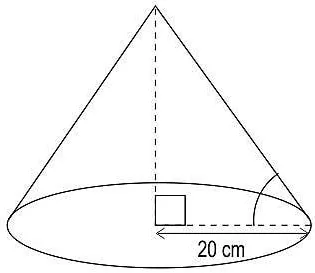
A right circular cone has volume 13,600 cm³ and base radius 20 cm. Find the angle which the slant height makes with the base radius. (Take π = 3 and √3 = 1.7.)
Step-marked solution
[1 mark] Volume = (1/3)πr²h = (1/3)(3)(20)²h = 400h = 13600 ⟹ h = 34 cm.
Two rectangular sheets, each of dimensions 45 cm × 155 cm, are folded to make hollow right circular cylindrical pipes, with exactly 1 cm overlap when sticking the ends. Sheet 1 is folded along its length (so its height is 155 cm) and Sheet 2 along its width (so its height is 45 cm). Both pipes are closed at both ends.
(i) Find the difference in the curved surface areas of the two cylinders.
(ii) Find the ratio of the volumes of the two cylinders formed. (Use π = 22/7.)
Step-marked solution
[1 mark] Sheet 1: height h₁ = 155 cm, circumference = 45 − 1 = 44 cm. Sheet 2: height h₂ = 45 cm, circumference = 155 − 1 = 154 cm.
A right-circular cylindrical water tanker (r = 1 m, h = 70 m) supplies water. Each colony has a cuboidal tank (7 × 2 × 3 m). Villages: 400 people fill spherical matkas (r = 21 cm). (i) How many colonies can one full tanker supply? (ii) If a tanker supplies 3 colonies then 400 matkas at a village, how much water (in m^3) does it supply? (Use π = 22/7.)
Source edition: NCERT Reprint 2026-27, Class 10 Mathematics, Ch 12 (jemh112.pdf, printed pages 161-170). One row per sourced item — every verbatim, example and NCERT figure traces to its page.
Item
Type
Source
Surface area of a combination of solids
verbatim
NCERT 2026-27 Ch12
Volume of a combination of solids
verbatim
NCERT 2026-27 Ch12
Why surface areas are not simply added
verbatim
NCERT 2026-27 Ch12
Total surface area is not additive
verbatim
NCERT 2026-27 Ch12
TSA of a cylinder with two hemispherical ends
verbatim
NCERT 2026-27 Ch12
TSA of a cone-and-hemisphere toy
verbatim
NCERT 2026-27 Ch12
Surface area of a combination (Summary)
verbatim
NCERT 2026-27 Ch12
Volume of a combination (Summary)
verbatim
NCERT 2026-27 Ch12
Combination of solids
verbatim
NCERT 2026-27 Ch12
Cone surmounted by a hemisphere - area to colour - NCERT Example 1
example
NCERT 2026-27 Ch12 Example 1 -164
Cylinder with a hemispherical depression - TSA - NCERT Example 4
example
NCERT 2026-27 Ch12 Example 4
Cuboid surmounted by a half-cylinder - volume of air - NCERT Example 5
example
NCERT 2026-27 Ch12 Example 5 -168
Hemisphere surmounted by a cone - volume and cylinder difference - NCERT Example 7
example
NCERT 2026-27 Ch12 Example 7
fig_capsule_1210
figure
NCERT 2026-27 Ch12 Fig. 12.10
Surface Areas and Volumes · spec-rendered note · NCERT Reprint 2026-27, Class 10 Mathematics, Ch 12 (jemh112.pdf, printed pages 161-170)